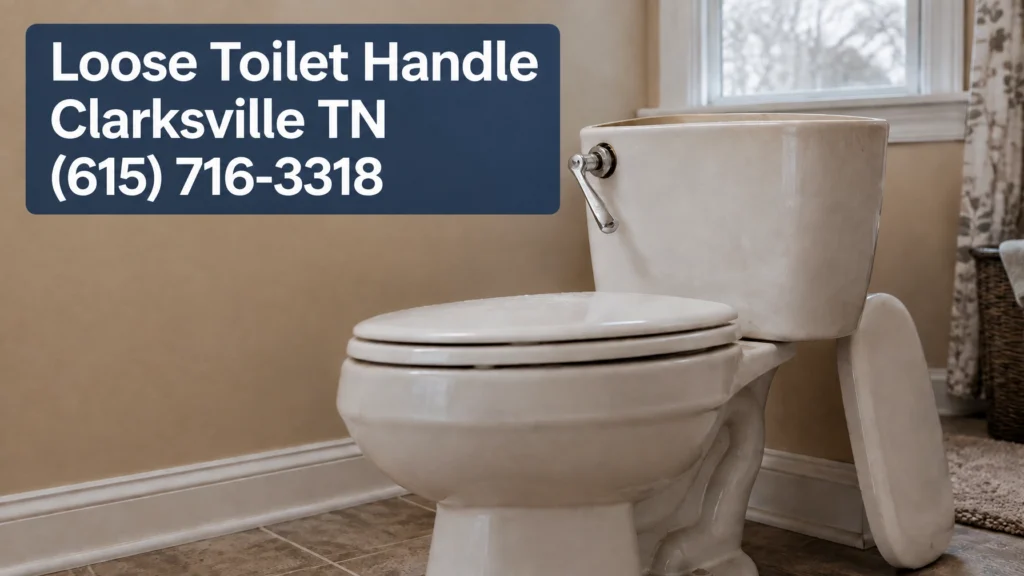
A loose toilet handle usually starts as a small annoyance. The handle feels rattly, the flush takes an extra push, or the lever hangs lower than it used to. In most cases, the fix is simple.
The part holding the handle to the tank may have loosened. The chain inside the tank may also have too much slack or may be catching on another part. This guide walks you through what to check before you decide whether to get matched with a local pro.
The same basic setup appears in many homes across Clarksville and Montgomery County, including bathrooms in Sango, St. Bethlehem, and near Fort Campbell.
1. Start by checking the handle and tank
Remove the toilet tank lid and set it on a stable surface. The porcelain lid can crack if it slips onto the floor or bumps against the wall.
Look inside the tank while moving the handle gently. You should see a metal or plastic lever arm connected to the handle shaft. A short chain runs from that arm down to the rubber flapper at the bottom of the tank.
Check for these common problems.
- The handle moves from side to side.
- The handle feels loose but the lever arm barely moves.
- The lever arm looks bent or cracked.
- The chain is tangled around the fill valve.
- The chain has no slack when the flapper is closed.
- The plastic retaining nut looks split or stripped.
A loose handle does not always mean the entire toilet needs repair. You usually do not need to remove the toilet, drain the bowl, or shut off water to the whole house.
If water is already leaking around the tank, shut off the small valve behind the toilet. If you are not sure which valve controls the fixture, the main water shutoff guide for Clarksville homes can help you understand the difference between a fixture valve and the main shutoff.

2. Tighten the retaining nut carefully
The retaining nut is on the inside of the tank, where the handle shaft passes through the porcelain. It may be white plastic, gray plastic, or metal.
Hold the handle steady from the outside while you inspect the nut inside the tank. Try tightening it by hand first. Many toilet handle nuts use reverse threads, so they tighten in the opposite direction from a standard nut.
Turn it gently. If the nut gets looser, turn the other way.
Once the nut feels snug, test the handle. It should sit firmly against the tank with very little movement. The lever arm should move smoothly when you press the handle.
If hand tightening does not hold it, use pliers for about one quarter turn. Grip the nut only. Do not squeeze the porcelain or twist the handle hard.
This is where many homeowners get into trouble. A porcelain toilet tank can crack from too much pressure, and a plastic nut can strip quickly. Snug is enough. You do not need to force the nut until it feels immovable.
A homeowner in Sango recently noticed a handle that felt loose after every flush. The handle nut had loosened, but the porcelain was fine. A small adjustment was all that was needed to make the handle feel solid again.
If the handle is still wobbling after the nut is snug, inspect the threads and the handle shaft. A worn part may need replacement.
3. Check the chain and flapper
The chain needs a little slack when the toilet is resting. Too much slack can make the handle feel weak because the lever moves before the flapper lifts. Too little slack can keep the flapper from sealing after the flush.
With the flapper closed, look for roughly one half inch to one inch of slack. The exact amount can vary by toilet design, but the chain should not hang in a large loop or pull tightly on the flapper.
Press the handle and watch the chain.
The flapper should lift high enough for a normal flush. The chain should move freely without catching on the fill valve. When you release the handle, the flapper should drop back into place and the toilet should stop running after the tank refills.
If the chain needs adjustment, unhook it from the lever arm and move the hook to another hole or chain link. Test the toilet again before cutting off any extra chain.
A short chain can cause a constant trickle because the flapper cannot close completely. A long chain can cause a weak flush or a handle that feels loose. Those small details matter in older bathrooms around St. Bethlehem, where replacement parts may not match the original setup exactly.

4. Replace a damaged handle or nut
A replacement handle may be the better choice if the handle arm is bent, the shaft is cracked, or the plastic retaining nut has split. Replacement handles are common and come in several shapes, finishes, and mounting styles.
Before buying one, check how the current handle attaches inside the tank. Take note of whether the lever arm is metal or plastic and how the chain connects to it. A universal handle may work, but some toilets need a specific style because of the tank design.
To replace the handle, shut off the water if the tank is full and flush the toilet. This lowers the water level and makes the parts easier to see. Disconnect the chain from the old lever, remove the retaining nut, and pull the old handle assembly through the tank wall.
Install the new handle in the same opening. Tighten the nut carefully, remembering that the threads may be reversed. Reconnect the chain and leave a little slack when the flapper is closed.
Turn the water back on and flush several times. Check for a steady handle, a complete flush, and a tank that stops filling without a hiss or trickle.
Do not use plumber’s tape to compensate for badly damaged threads. That may hold for a short time, but it does not correct a cracked handle or stripped nut.
If the porcelain around the handle opening has a hairline crack, stop there. Tightening the nut farther could make the damage worse.
5. Know when to get matched with a pro
A loose handle is often a reasonable small repair, but not every toilet problem stays small. Get matched with a pro if the tank is cracked, water is leaking onto the floor, the shutoff valve will not close, or the toilet keeps running after the handle is adjusted.
You should also get help if the handle feels firm but the toilet still will not flush properly. The problem could involve the flapper, fill valve, clogged trap, or another part inside the tank.
A Woodlawn homeowner may see a different setup from a newer home near Fort Campbell. Older toilets can have corroded hardware, brittle plastic, or replacement parts that no longer fit well. Do not force a part that feels stuck.
Fix It Quick is a referral network, not a repair crew. The Network does not perform repairs or quote jobs. We connect homeowners with vetted local pros, and the pros in our network are licensed and insured.
You can review the handyman services available through the Network for fixture and general repair needs. The Fix It Quick blog also includes practical guidance for issues such as a slow draining sink and other home repairs.
If you live in Clarksville or elsewhere in Montgomery County and would rather have the work handled, call or text (615) 716-3318 or request a free match. You can describe the loose handle, share a photo, and take the next step without pressure.
6. Frequently asked questions
Why does my toilet handle keep getting loose?
The retaining nut may be loose, the handle threads may be worn, or the lever arm may be cracked. The chain can also pull at an angle and gradually loosen the assembly.
Which way does a toilet handle nut tighten?
Many toilet handle nuts use reverse threads. Turn it gently and watch whether it gets tighter or looser. Stop if you feel strong resistance.
Can I tighten the handle without shutting off the water?
Usually, yes. You can remove the tank lid and tighten the retaining nut while the tank is full. Shut off the fixture valve first if water is leaking or if you need to replace the handle.
Why does the toilet run after I tighten the handle?
The chain may be too tight, the flapper may not be sealing, or the handle arm may be bent. Check that the chain has a little slack and that the flapper drops fully after the flush.
Can a cracked toilet tank be repaired?
A hairline crack in the tank can grow under water pressure. Do not keep tightening the handle or rely on a patch without getting advice from a qualified pro. Replacement may be safer.
Can Fix It Quick repair my toilet handle?
Fix It Quick does not perform repairs directly. The Network can match you with a vetted local pro in Clarksville, Sango, St. Bethlehem, Fort Campbell, Woodlawn, or nearby Montgomery County.