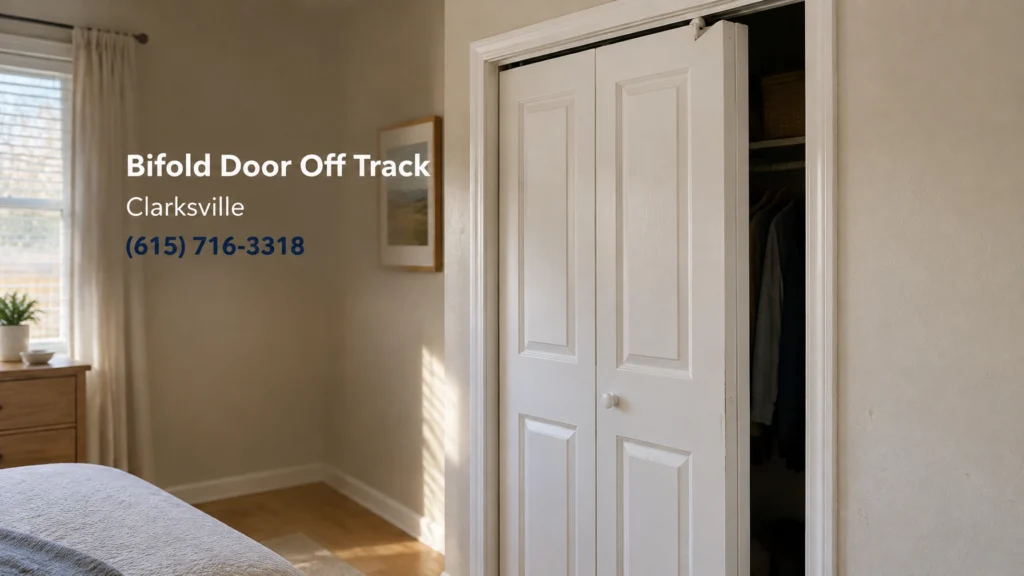
A bifold door that jumps its track can go from mildly annoying to hard to open in a hurry. Often, a guide pin has slipped out or a bracket has loosened. Don’t force the panels. A little checking first can keep a simple adjustment from becoming a damaged door or jamb.
This guide walks through the common checks and a careful way to reseat the door. Hardware varies, so follow the door maker’s instructions if you have them.
1. Find out why the door slipped
Start by looking before moving anything. Check whether the top guide came out of the rail, the bottom pivot slipped from its bracket, or the panels are rubbing the frame. Look for a bent top pivot bracket, a loose track screw, or a hairline crack in the door jamb.
If the door still moves, open and close it gently. Watch where it catches and whether the top gap looks uneven. That usually tells you whether you have a slipped pin, a sagging door, or a shifted track.
A sticky door guide for Clarksville homes can help if the bifold also rubs the frame. If the door is badly crooked, stop there.
2. Make the area safe before adjusting anything
Support the door before reseating it. Bifold panels can fold fast and pinch fingers. Keep kids and pets clear.
If the door is tall, heavy, or part of a four panel set, have someone steady it. Move storage bins or shoes out of the opening so the panels can fold freely. A quick photo of the pivots and brackets can help if you need to put parts back the same way.
In Clarksville and Montgomery County, older closet doors often have worn or mismatched hardware. If a bracket is cracked, the track is loose, or a pin has pulled out of the door, pause before rehanging it.
3. Check the track, pivots, and brackets
Inspect the top track first. It should be tight, straight, and fully attached to the header. Check that the guide pin or roller moves freely and actually fits the track channel.
Then check the bottom pivot and bracket. The pin should sit in its slot, not beside it, and the bracket should feel secure. If the pivot block is split or the pin is loose in the door, pushing it back in usually won’t last.

Look for loose screws, a cracked plastic guide, or a worn roller. Don’t bend hardware back by guesswork or swap in a random pin. Small size differences matter.
4. Reseat the door carefully
Only do this if the track and hardware look sound. Fold the door partway, then lift just enough to take pressure off the bottom pivot. Don’t twist the panels.
On many bifold doors, the top pivot sits in a bracket while a separate guide pin or roller runs in the track. Line each part up with the right opening, then lower the bottom pivot back into place while supporting the door.
Some guides are spring loaded and need to be pressed down briefly to align with the track. Release the pin only when it is directly under the channel. Stop if the door won’t lift easily or a part looks damaged.
5. Adjust the height only if needed
If the door is back on track but still drags, it may need a small height adjustment. Look for a threaded bottom pivot or adjustment collar. Take the weight off the pivot before turning it.
Make small changes and test after each one. Aim for an even top gap and enough floor clearance so the door opens without rubbing. If the door still leans, a bracket may be loose or out of line.
6. Test the movement and watch for repeat problems
Open and close the door slowly a few times. The panels should fold smoothly, stay in the track, and clear the floor and jamb. If it jumps off again, stop and inspect the hardware instead of forcing it back.
Closet storage can cause repeat problems too. In a St. Bethlehem home, a bifold kept slipping because the upper guide was worn and stacked bins were pressing against the panels from behind. Once both issues were found, the next step was a much simpler fix.
If storage is part of the problem, this guide to a sagging closet rod and shelf covers another common closet issue.
7. Know when to get matched with a pro
DIY makes sense when a sound pin has simply slipped out and the door is light enough to handle safely. Get matched with a pro if the track is bent or loose, the pivot block is cracked, the jamb is splitting, or the door keeps dropping out of line.
Across Clarksville, Sango, Fort Campbell, and Montgomery County, older bifold doors often have more than one issue at the same time. A simple adjustment usually costs less than replacing damaged hardware or repairing surrounding wood. The pros in our network are licensed and insured, and the final cost depends on the door style, the parts needed, and whether the track or jamb also needs repair.
8. Get help without adding pressure
If the door won’t stay on track or you’ve found a broken part, you don’t need to keep guessing. Fix It Quick Network can match homeowners in Clarksville, Sango, St. Bethlehem, Fort Campbell, and across Montgomery County with a vetted local pro. We’re a referral network, not a repair crew.
If you’d like help with the next step, call or text (615) 716-3318 or request a free match. A photo of the track and pivot helps. That’s enough to get started.
9. Frequently asked questions
Why does a bifold closet door keep jumping off track?
Usually because of a worn guide pin, loose bracket, bent track, or bottom pivot that is not seated correctly.
Can I put a bifold door back on track by myself?
Sometimes, yes, if the door is light and the hardware is still sound. Stop if the panel is hard to lift or a part looks damaged.
Should I replace a bent top pivot bracket?
Usually yes. A bent bracket may not hold the pivot securely, even if you bend it back.
Why does the door scrape the floor after I reseat it?
It may need a small height adjustment, or one of the brackets may still be loose or out of line.
When should I stop trying to fix it?
Stop if the track has pulled away, the pivot block is cracked, the jamb is splitting, or the door keeps slipping back out.