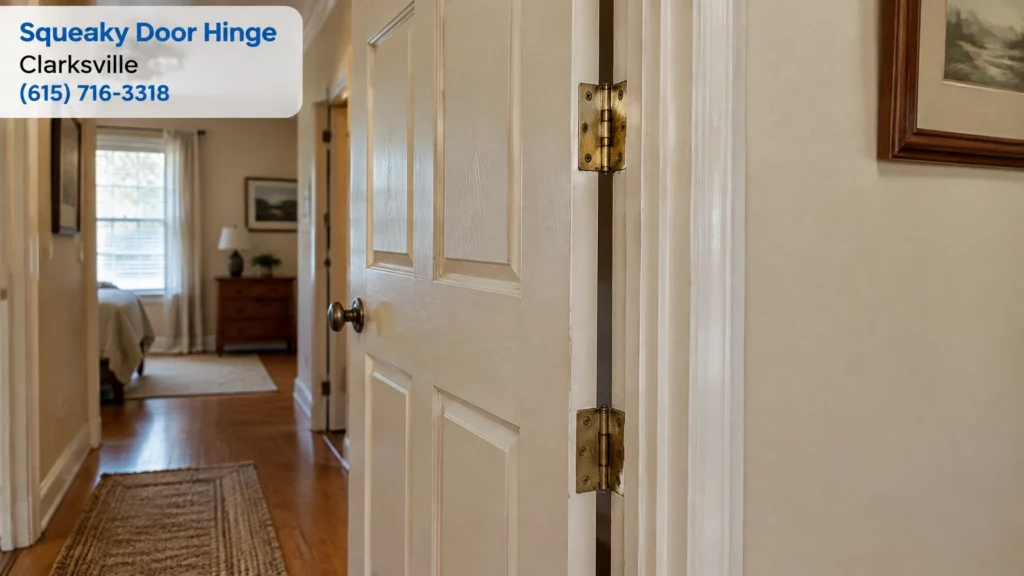
A squeaky passage door can make a quiet home feel anything but quiet. The good news is that the noise often comes from friction at the hinge pin, and a careful clean and small amount of lubricant may be enough. In Clarksville, seasonal humidity and everyday dust can both contribute.
This guide covers interior and exterior hinged doors, not cabinet hinges. Start with the simple checks, and stop if the door feels heavy or the hinge looks damaged.
1. Find the hinge that makes the noise
Listen before taking anything apart. Open and close the door slowly, then pause at each hinge to hear where the squeak is loudest. Check one hinge at a time, since the sound can travel through the door and make the source hard to pinpoint.
Look closely at the hinge pin and knuckles. A little gray powder on the pin or a faint black smudge on the white jamb can point to rubbing or old grime. Paint on the moving parts can also cause friction. In Clarksville and across Montgomery County, dust and damp weather may add to the buildup.

If the sound comes from a particular hinge, that’s the place to start. If you hear rubbing along the door edge instead, that’s a different issue from a hinge squeak.
2. Understand why a hinge squeaks
Squeaks usually come from friction between the pin and hinge knuckles. Old lubricant can dry out, while dust and grit can collect around the moving parts. Moisture and seasonal humidity in Middle Tennessee may also contribute to corrosion over time.
Check for obvious dirt, paint, rust, or a loose hinge before adding anything. A light silicone-based spray or a drop of household oil can help lubricate a clean hinge. Use a small amount. Heavy grease can hold dust, and excess oil may drip or stain nearby paint or flooring.
A squeak that continues after careful lubrication may have a different cause, such as a worn or bent hinge. Don’t keep adding more product if the sound isn’t changing. The takeaway is simple, find the source before trying to quiet it.
3. Clean and lubricate one hinge at a time
A small, controlled application is usually the right place to start. Put a rag beneath the hinge to catch drips, then apply a little silicone-based spray to the hinge knuckles. If using household oil, place just one drop at the point where the hinge parts move. Swing the door several times and wipe off any excess.
If the squeak remains and the hinge has a removable pin, clean the pin directly. Close the door and support its weight before beginning. Tap the bottom hinge pin upward from below with care, then remove it only if it moves freely. Don’t force a stuck pin or try this on a heavy door that isn’t safely supported.

Wipe old grease and gray residue from the pin, then clean the hinge knuckles with a rag. Apply a small amount of lubricant, reseat the pin fully, and swing the door several times. Repeat with another hinge only after the first pin is back in place. In Sango, a bedroom door used all day may simply need this sort of focused attention.
4. Check the screws without confusing the problem
Snug hinge screws can help keep a hinge steady, but tightening screws doesn’t directly lubricate a squeaky pin. Use a hand screwdriver and stop as soon as the screw feels firm. Don’t overtighten it.
If a screw spins without tightening, the hole may be stripped. One possible repair is to fill the hole with wood glue coated toothpicks, let the glue set, and reinstall the screw. A longer screw may also work if it reaches solid framing. If that feels uncertain, leave the screw alone and get advice rather than forcing it.
Loose hinges can let a door sag or shift. That’s a door support or alignment concern, distinct from a squeak caused by friction at the pin. If a door rubs or feels like it has dropped, see our guide to a door that sticks or rubs. The takeaway is to fix the cause you can see, not tighten every screw by guesswork.
5. Know when the noise points to a bigger issue
A squeak that returns quickly may be a sign the hinge needs more than lubrication. Look for a sagging door, a rubbing edge, a bent hinge, rust after years of moisture, or a hinge that feels loose in the frame. Don’t force the door or keep working a pin that won’t move.

A familiar example in a St. Bethlehem home is a bedroom door that squeals near the bottom hinge each morning, while a dark smudge appears on the jamb. The sound may be friction, but if the door also sags or the hinge is rusted, lubrication alone may not solve it.
A simple lubrication fix is often minor. Replacing a hinge can raise the cost, and the door’s weight, hardware, access, and condition all matter. As a broad planning range, hinge work may run about $75 to $200, depending on the door and hardware. That isn’t a firm quote. Homes near Fort Campbell or in Woodlawn may have different door types and repair needs, so an on-site look can change the cost.
If the door also won’t latch, that’s a different problem from a squeak. Our guide to an interior door that won’t latch covers that issue separately.
6. Get matched with a local pro if needed
You don’t have to take a door apart to solve every squeak. If the hinge pin is stuck, the door feels heavy, the hinge is bent or rusted, or the noise keeps coming back, pause and get help. The practical takeaway is to avoid forcing a repair that doesn’t feel safe.
Fix It Quick Network is a referral network, not a repair crew. We match homeowners, realtors, property managers, and investors in Clarksville and Montgomery County with vetted local pros. The pros in our network are licensed and insured.
If you'd like a vetted local pro to take a look, call or text (615) 716-3318 and request a free match. Tell us which door squeaks and when you first noticed the sound. That’s a helpful next step.
Frequently asked questions
Can I use household oil on a squeaky door hinge?
A small drop may help with a simple squeak. Apply it carefully, since excess oil can drip or stain nearby surfaces.
Should I remove every hinge pin?
No. Work on one hinge at a time, and reseat its pin before moving to another. Don’t remove a pin if the door isn’t safely supported.
Why does my hinge squeak again after lubrication?
The hinge may have dirt, wear, rust, or a bent part. A loose hinge or sagging door may also need attention beyond lubrication.
Is heavy grease a good choice?
Heavy grease can attract dust and grit. Use a small amount of a suitable lubricant and wipe away the excess.
When should I get matched with a pro?
Get help if a pin won’t move, the door is heavy, the hinge looks bent or badly rusted, or the squeak returns after a careful cleaning and lubrication.