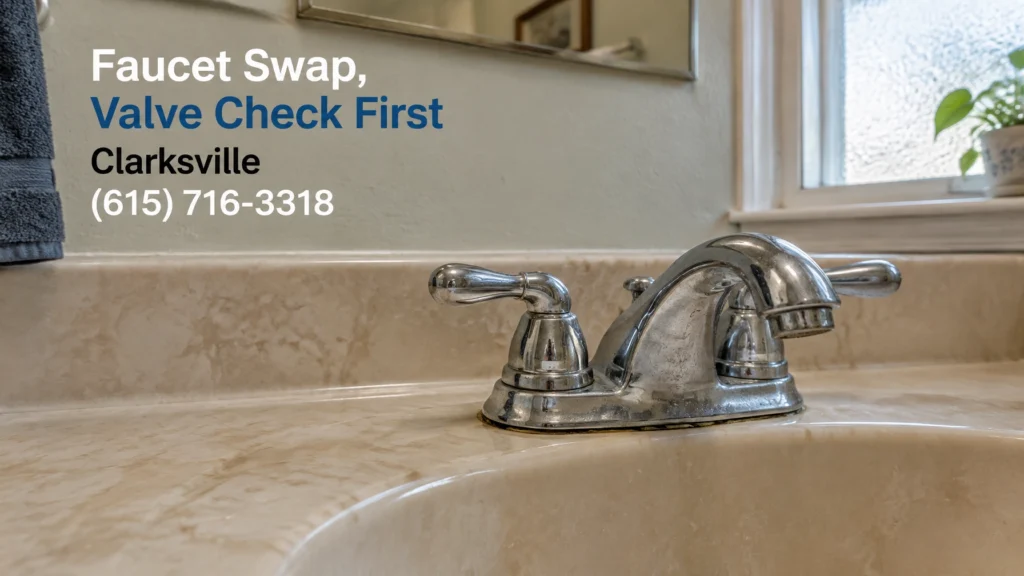
1. Know what the job really involves
A faucet swap has two halves. The first is removing the old fixture and setting the new one. The second is getting the shutoff valves under the sink to close and stay dry.
That second half decides whether a weekday morning job stays simple. In older Clarksville and Fort Campbell area homes, the valves may be original gate valves that haven’t been turned in years. A valve that turns a half turn and then weeps at the packing nut can turn a quick swap into a same-day call.
A Sango guest bathroom faucet had been dripping since spring, but its shutoff under the vanity wouldn’t close. The water had to go off at the main before the faucet could be changed. That’s why this is a small plumbing job with a clear stopping point, not a project to start the night before holiday guests arrive.
Fix It Quick Network is a referral network, not a repair crew. A loose handle or worn cartridge is a different fix, covered in this guide to a loose bathroom faucet handle.
2. Check the shutoffs and deck before buying anything
Test the valves before choosing a faucet. Turn each handle gently toward closed, then open the faucet to release pressure. If water keeps flowing, or a valve leaks as it turns, don’t force it.
If the valves won’t close fully, shut off the house water at the main and open a low faucet to drain the line. This main water shutoff guide can help locate it. A stuck or weeping valve is the most common reason a simple swap turns into a same-day call. Stop and get a pro if a valve won’t close, its body moves in the wall, or an old supply-line nut starts to round off.

Check the vanity top, too. Note whether the faucet uses one hole or three, and measure the distance between the outer holes if you’re considering a wide-spread faucet. A hole that’s too large, a chipped deck edge, or a soft spot means stop and look at the sink first. A deck cracked through is a countertop problem, not a faucet problem.
3. Buy the right faucet and the parts that come with the job
Measure first, then choose a faucet that fits the sink holes. A single-hole faucet may include a plate to cover a three-hole setup, but check the product details rather than assuming it will fit. A wide-spread faucet needs the outer holes at the right spacing.
Plan to replace the braided supply lines while the sink is open. Don’t reuse old ones just because they look all right. Braided stainless lines have a service life, and a date is printed on the tag.
Most new faucets include a gasket and mounting hardware. Read the manufacturer’s sealant instructions before setting the fixture. Some call for plumber’s putty, some for silicone, and some for a dry gasket. Use only what the instructions specify. Mixing sealants or tightening too hard can damage the seal or crack a cultured marble deck.
Check the box for a drain pop-up before buying one separately.
4. Get the old faucet out without breaking the sink
Cover the drain or put the stopper in, and spread a towel below the work area. Small nuts and clips are easy to lose in the cabinet. Before loosening any connection, confirm the water is off and the lines have drained.
Disconnect the old supply lines, then reach behind the bowl to loosen the mounting nut. A basin wrench is made to reach that awkward spot. Old nuts are often corroded, so have the water off and the line drained before forcing one. Stop if a nut begins to round off or the valve shifts.

Once the faucet is free, lift it out without prying against the sink surface. A ring of old plumber’s putty may be hard and cracked like a dried cracker under the base. Clean the residue gently so the new gasket can sit flat, and avoid scratching or chipping the deck. If removal exposes a crack or soft material, pause instead of installing over it.
5. Seal, set, and connect the new one
Follow the faucet’s instructions for its gasket or sealant. Set the fixture through the correct holes, align it square with the sink, and secure the mounting hardware. Tighten enough to hold it in place, but don’t crank down on the nut. Cultured marble can crack under too much pressure.

Connect new supply lines, matching hot to hot and cold to cold. Tighten the connections hand tight, then give each a small additional turn. Gorilla-tight isn’t better. It can damage a fitting or washer and make a small leak harder to spot.
Keep the lines in a gentle curve, without kinks or tension. Recheck that the faucet is straight before finishing the mounting nut. In a Clarksville or Montgomery County home with an older vanity, leave room to see the connections during the leak check.
6. Test it properly, then watch it for a day
Open the shutoff valves slowly, then run both hot and cold water. Use a dry paper towel on each valve under the sink, each connection at the faucet tail, and the spout and faucet base. A bead of water shows up on paper before it shows on a cabinet floor.
If a valve, faucet connection, or base begins to seep, shut the water off and address the cause before using the sink normally. Check again after a day of regular use. A slow weep can take time to show itself. If the new faucet has weak flow, check the instructions for flushing the lines and cleaning the aerator, or read this guide to weak faucet water flow.
A guest bath in St. Bethlehem or Woodlawn doesn’t need a rushed fixture change right before company arrives. Pick a weekday morning, when there’s time to stop if the valves or sink deck tell a different story. For broader holiday faucet prep, see this seasonal faucet guide.
If you’d rather have help, call or text (615) 716-3318, or request a free match with a vetted local pro. The pros in our network are licensed and insured. Cost follows a general range, and tight access, worn valves, or a sink deck that needs work push it higher. A practical next step is to test the shutoffs before buying the faucet.
Frequently asked questions
How long does a bathroom faucet replacement take?
A straightforward swap may take a few hours, including setup and leak checks. Corroded fittings, stubborn valves, or a damaged deck can add time.
Does the water need to be shut off for the whole house?
Only if the valves under the sink won’t close fully or safely. If the main is shut off, open a low faucet to drain the line before loosening connections.
Can a two-handle faucet be swapped for a single-handle one?
Sometimes, if the faucet’s plate covers the existing holes and the deck is sound. Check the hole layout and the new faucet’s fit before buying.
Why does water seep around the base of a new faucet?
The gasket may be out of place, or the manufacturer’s sealant instructions may not have been followed. Shut the water off if needed, then check the installation rather than tightening the base excessively.
Should the shutoff valves be replaced at the same time?
Not automatically. If a valve won’t close, weeps when turned, or moves at the wall, stop and have a pro assess it before continuing.