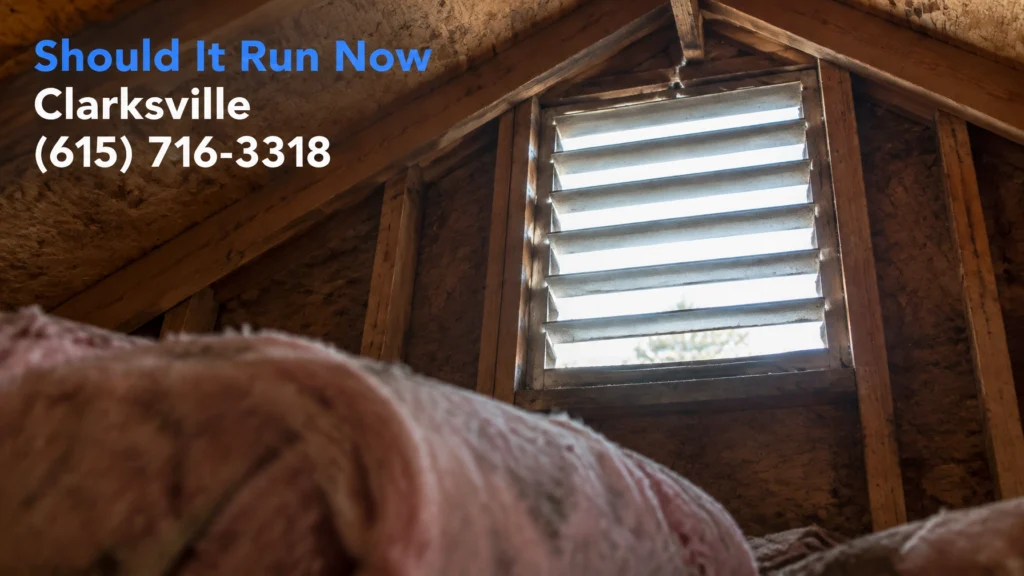
Most attic fan questions in late November aren’t really about whether the fan should run. They’re about whether it’s set so it can’t run, and whether the opening is closed. In Clarksville, two attic checks answer both questions, the thermostat dial and the louver.
1. Know what an attic fan is for, and what it is not for
A powered attic fan is mainly a summer tool. It exhausts hot attic air through a gable or roof mount, which can lower attic temperatures on a sunny afternoon. In November, a Clarksville attic doesn’t need one running.
An attic fan isn’t a whole house fan. A whole house fan pulls air through the living space, while an attic fan exhausts air from the attic. It also isn’t a moisture cure. If warm, damp air from the home leaks into the attic, running an exhaust fan can pull more conditioned air through those gaps instead of fixing the source.
Montgomery County weather can shift from mild afternoons to chilly nights. That doesn’t mean the fan needs to cycle with every temperature change. Start by checking its control and the louver.
2. Find the thermostat and read the setting before changing anything
The thermostat is usually a small dial or box on attic framing near the fan. It may sit on a stiff wire lead. A common summer setting is around 100 to 110 degrees, but some fans are set much lower, at 80 or 85. On a mild, sunny afternoon, a south-facing roof can warm the attic enough to trigger one of those low settings.
Look closely before adjusting it. A thermostat dial up on the gable framing may have printed numbers rubbed to nothing, with the pointer worn a bright shiny track in one spot. Don’t guess at a worn setting. Check the fan’s instructions if available, and don’t open the fan housing or touch wiring.

In Sango, a bright afternoon can feel mild outdoors while the roof warms the attic above it. That’s one reason a fan may cycle even when the season has changed. The dial tells you what temperature it’s responding to, not whether it’s the right time of year to run.
3. Shut it down for the season on purpose
Use the thermostat dial or a dedicated wall switch, if the fan has one. Don’t shut off a breaker unless it’s labeled for the fan alone. The same circuit may also feed attic lighting or a furnace.
Don’t unplug a hardwired unit. If there’s no switch and the fan is hardwired, the honest answer is that this is a small job for an electrician or handyman. Avoid opening the housing to find a shortcut.
A St. Bethlehem homeowner heard the attic fan kick on during a warm Thanksgiving afternoon, then heard it run again on a cold morning two weeks later. The dial was near 80, and the thermostat was stuck on. A vetted local pro turned the dial down and replaced the thermostat, which stopped the cycling.
4. Close the hole, because a fan that sits open is a chimney
A louver or shutter that doesn’t sit flat can let cold outdoor air and warm house air trade places all winter. From the attic side, check whether the blades close evenly. Bent blades, a missing spring, or blades hanging an inch open are common on older Clarksville installations.

Some fans have a backdraft damper, and some don’t. A removable insulated cover on the attic side may be reasonable if the fan is reachable and the manufacturer allows it. Refrigerator-box and foam-board improvisations are common, but the cover must not block the louver from outside or trap moisture.
If the attic access itself is drafty, check that the hatch closes properly. This guide explains an attic ladder that will not close right.
5. Watch for the two signals that mean stop and get help
A fan that keeps running in winter after the dial has been turned down points to a thermostat that may have failed closed. Don’t keep changing settings to work around it. Have the control checked.
The second signal is more serious. A powerful exhaust fan in a tight attic can pull the house into negative pressure and interfere with venting from a natural-draft gas appliance, such as a water heater or furnace. If gas equipment is in the attic or in the mechanical closet below, a fan running hard is a safety question, not a comfort question. Stop and get qualified help.
Frost or dark staining on the underside of roof sheathing is also a reason to pause. It can point to an air movement or ventilation problem that needs a specialist, not just a different fan setting. For related warning signs, see fall roof and attic leak checks for Clarksville homes.

6. Know what belongs to a pro
Adding a fan, installing a new circuit, or mounting a fan on the roof takes more than a dial adjustment. Get a specialist for a gas flue concern or sheathing moisture. A fan that trips a breaker needs an electrical check rather than repeated resets.
A thermostat swap or louver repair is often a smaller job. General costs can range from the low hundreds for a simple repair to several hundred dollars or more for a replacement or added switch. The cost depends on whether the fan is hardwired, whether a switch needs to be added, and whether the louver can be repaired or must be replaced.
For homes in Woodlawn or near Fort Campbell, the same basic checks apply, but the actual fan and wiring determine what work is needed. Pros in the Fix It Quick Network are licensed and insured. The network can match you with a vetted local pro for a small repair, or point you to the right specialist for a bigger concern.
If you’d like help sorting out the next step, call or text (615) 716-3318 or request a free match. Share whether the fan runs, what the dial shows, and whether the louver closes flat. A clear description is a practical place to start.
Frequently asked questions
Should an attic fan run in the winter in Clarksville?
Usually, no. In November, a Clarksville attic doesn’t need a powered fan running for summer cooling. Check the thermostat and make sure the louver closes.
What should the attic fan thermostat be set at?
A typical summer setting is around 100 to 110 degrees, though controls vary. For winter, don’t rely on a generic setting. Follow the fan’s instructions and make sure the unit is set so it won’t run unnecessarily.
Is an attic fan the same as a whole house fan?
No. An attic fan exhausts hot air from the attic. A whole house fan pulls air through the living space and sends it into the attic.
Can a cold draft come down through the attic fan in winter?
Yes. A louver or damper that doesn’t close flat can leave a path for cold air. Check for bent blades, a missing spring, or a visible gap.
How much does it cost to fix or replace an attic fan?
A simple thermostat or louver repair may cost in the low hundreds. A new fan, added switch, or wiring work can cost several hundred dollars or more, depending on the setup.