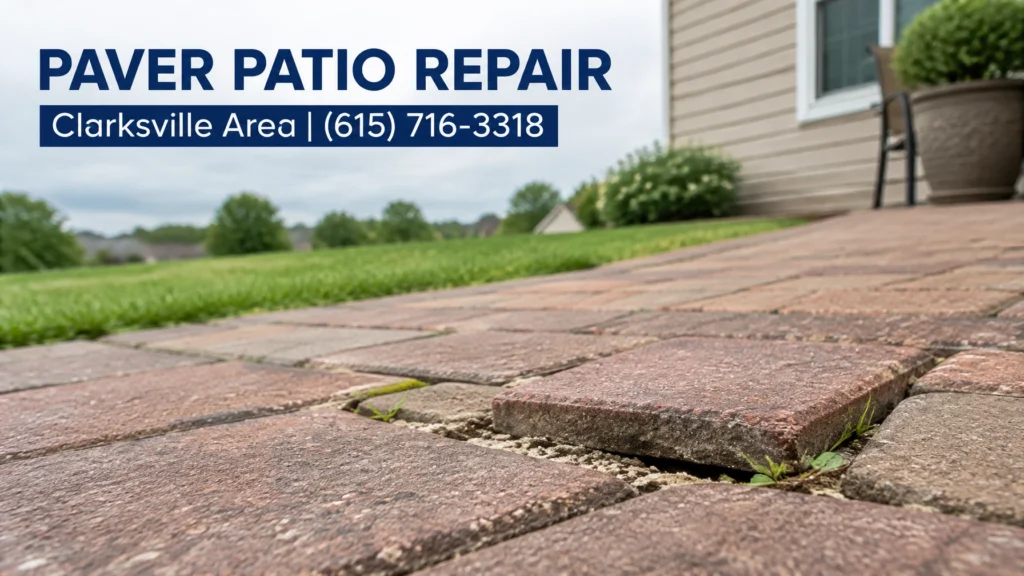
A paver patio or walkway can look fine from across the yard and still feel wrong under your feet. One paver rocks when you step on the corner. A joint has washed out, leaving a half inch gap. The front step sits lower than it did last year.
These are common hardscape problems around Clarksville and Montgomery County. Wet springs, heavy storms, shifting soil, roots, and poor base preparation can all move pavers and small landscape walls. The good news is that not every uneven spot needs a full replacement.
The right repair depends on what moved, why it moved, and whether the base underneath is still sound.
1. Know what a failing paver surface looks like
Start with the walking surface. A failing patio or walkway usually gives you a few clear clues before it becomes a larger problem.
Look for these signs.
- A paver that rocks or clicks when stepped on
- A low area where water remains after rain
- A raised edge that catches a shoe
- Washed out joint sand between pavers
- Weeds growing through wide or empty joints
- Edging that has spread away from the pavers
- A step that feels loose or tilted
- A walkway that slopes toward the house
A loose paver is not always a major repair. If the surrounding pavers are level and the base is firm, one unit may only need to be lifted, cleaned, and reset. If several pavers have settled together, the base below them may have lost its shape or strength.
Pay close attention near downspouts, door thresholds, driveways, and steps. Those areas see more concentrated water and foot traffic. A walkway that keeps settling in the same place needs more than a fresh layer of sand.
2. Understand why pavers shift in Clarksville weather
Weather and soil movement often work together. Heavy rain can saturate the soil beneath a patio, while long dry periods can cause some soils to shrink and leave voids under the base.
Clarksville also sees strong storms that can move water across yards quickly. If a downspout empties beside a patio, the runoff may wash out joint sand and soften the soil beneath the edge. A patio built over loose fill or an old utility trench may settle even when the rest of the yard looks stable.
Other causes include.
- Poorly compacted base material
- Too little crushed aggregate below the pavers
- Missing or loose edge restraint
- Tree roots lifting the edge
- Water flowing toward the house
- Soil washed away behind a low wall
- A walkway built over disturbed ground
The city and county have guidance about erosion control and disturbed soil. Homeowners can also check the Clarksville permitting page before changing grades, building steps, or altering a permanent landscape feature.
The simple point is this. Pavers usually move because something below or beside them moved first.
3. Decide what you can reasonably check yourself
Small, isolated repairs may be reasonable for a capable homeowner. Start with observation rather than removal.
Walk the entire patio or walkway after a rain. Notice where water flows, where it pools, and whether a downspout is discharging beside the hardscape. Check whether the edge restraint has pulled away. Press on a few pavers around the problem area to see if the movement is limited or widespread.
You may be able to handle these tasks if the base is firm and the area is small.
- Remove weeds from stable joints
- Sweep new joint sand into clean, dry gaps
- Replace one or two matching pavers
- Reset a small isolated paver
- Extend a downspout away from the patio
- Clear leaves and soil from drainage paths
Call 811 before digging. Wear eye protection and gloves, and avoid compacting wet or saturated soil.
Do not simply add sand to a low patio that has settled repeatedly. Do not shim a moving step with loose material. If the area borders a foundation, pool, driveway, utility line, or retaining wall, get a second opinion before digging.
A small cosmetic reset is one thing. Rebuilding the base is another.
4. Rebuild the base instead of covering the problem
A lasting paver repair usually depends more on base preparation than on the pavers themselves. Adding sand on top may make the surface look level for a short time, but it does not correct soft soil, poor drainage, or missing aggregate.
A proper re-lay often includes these steps.
- Remove and mark the existing pavers so the pattern can be restored.
- Excavate unstable soil, loose fill, or failed base material.
- Correct the grade so water moves away from the home.
- Add suitable crushed aggregate in compacted lifts.
- Install a thin, consistent bedding layer.
- Relay the pavers and replace damaged edge restraint.
- Fill the joints with compatible joint material.
The exact base depth depends on the soil, slope, use, and site conditions. A footpath and a vehicle area do not need the same preparation. Manufacturer guidance commonly calls for several inches of compacted crushed stone beneath pedestrian pavers, with the bedding layer kept thin and even.
The pros in our network can document the repair plan before work begins. That helps homeowners understand whether the job is a reset or a partial rebuild.

5. Treat joint sand as part of the repair
Joint sand helps hold pavers in place and limits movement between individual units. It also affects weeds, insects, and water washing through the surface.
Regular joint sand is simple to replace. It works well for many small repairs, but it can wash or blow out over time. Polymeric sand includes a binder that hardens after it is installed and activated with water. It can reduce weed growth and erosion when the joints are clean, dry, and filled correctly.
Polymeric sand is not a substitute for a stable base. If the patio is sinking, the joints will move again no matter which sand is used.
Before re-sanding, remove loose material and weeds from the joints. Clean the paver faces, let everything dry, and fill the joints fully. Follow the product instructions for compaction, watering, temperature, and cure time. Keep the finished joint slightly below the top of the paver so the material does not wash across the surface.
A few weeds do not always mean the patio needs to be rebuilt. A half inch gap, loose edges, and recurring washout tell a different story.
For related exterior upkeep, the Fix It Quick services page includes exterior work, general repairs, and referrals for jobs that fall outside a basic handyman visit.
6. Give settled steps and thresholds extra attention
A settled step deserves more attention than a loose patio paver. Steps carry concentrated weight, and a small change in height can create a trip hazard.
Check whether the step is level from side to side. Look at the riser height, the tread depth, and the gap between the step and the door threshold. A step that has pulled away from the door may allow water to collect near the entry. A step that tilts toward the house can send runoff in the wrong direction.
One St. Bethlehem rental had a patio step that had settled away from the back door after repeated wet weather. The gap was narrow, but tenants noticed the step moved slightly underfoot and water collected near the threshold. The repair needed the base and the transition checked together, not just a layer of sand added beneath the edge.
The brick and mortar repair guide for Clarksville can also help if the settled step includes masonry joints or loose brick.
A homeowner may be able to reset a small, stable landscape step. Get matched with a pro if the step is moving, undermined, attached to a wall, or connected to a structural porch. The same applies to front steps near Fort Campbell homes where quick turnover and safe access matter.
7. Keep low garden wall repairs within a safe scope
Low landscape walls can often be repaired when the problem is limited to a cap stone, a small section of loose block, or minor joint movement. A hairline crack through one cap stone may call for replacement rather than a full wall rebuild.
First check whether the wall is leaning, bulging, separating, or sliding. Look behind the wall for standing water, washed out soil, or a blocked outlet. Check the base and the area at the wall toe for erosion.
A reasonable small repair may include.
- Resetting one loose cap stone
- Replacing a damaged landscape block
- Rebuilding a short, isolated section
- Restoring missing drainage stone
- Clearing soil from a small outlet
- Replacing a failed adhesive where appropriate
The limits matter. A wall taller than about three or four feet, a wall holding a slope above a structure, or a wall showing obvious structural movement needs a qualified retaining wall specialist or engineer. A wall supporting a driveway, building, steep bank, or large surcharge should not be treated as a routine handyman repair.
Clarksville requirements can vary by location and scope. Ask Building and Codes what applies before construction. The fall drainage and grading checks guide is useful for general questions, but it does not replace a site-specific review.

8. Consider the repair timing for real estate work
Hardscape condition affects how a property feels before anyone reaches the front door. Uneven pavers, a loose step, or a leaning garden wall can make buyers wonder what else has been left unattended.
For a seller in Sango, a clean and level walkway may be a more useful pre-listing repair than adding decorative plants. In Woodlawn, a rental entrance that feels solid and easy to walk can help a property show better during turnover. A small repair does not need to look new. It needs to feel safe, clean, and cared for.
Realtors and property managers can group related items into one visit.
- Loose pavers near the entry
- Settled steps and thresholds
- Broken cap stones
- Washed out joints
- Small edge restraint repairs
- Minor exterior touchups
Investors managing several homes across Montgomery County may also benefit from coordinating similar exterior repairs together. A written list with photos, property addresses, access notes, and timing requirements makes multi-property work easier to organize.
The fall deck and porch prep guide for Clarksville homes and rental properties offers related guidance for preparing entries and exterior details before showings.
9. Know when to get matched with a pro
The honest DIY answer is that small surface repairs can be manageable. The handoff makes sense when the cause is unclear, the repair is spreading, or the work involves excavation and compaction.
Get matched with a pro when.
- More than a few square feet have settled
- The same area fails after each wet season
- A step moves underfoot
- Pavers are sinking near the foundation
- A wall leans, bulges, or has a spreading crack
- Drainage needs to be redirected or rebuilt
- Tree roots or utilities are involved
- Matching pavers are hard to find
- The repair connects to a driveway or structural porch
The pros in our network are licensed and insured. Fix It Quick Network does not perform repairs as its own crew. We match homeowners, realtors, property managers, and investors with vetted local pros for appropriate repair work.
Major grading, drainage engineering, tall retaining walls, structural framing, full roof work, and major HVAC, electrical, or plumbing jobs should go to the right specialist.
10. Understand general cost ranges before work begins
Hardscape costs vary widely, so a firm number cannot be given without seeing the surface and the base. Access, disposal, materials, matching pavers, drainage, stairs, and wall work can all change the final cost.
For planning purposes, published Tennessee cost guides often place small paver resets in the low hundreds when only a limited area is involved. Larger repairs that require lifting, excavation, new aggregate, compaction, and relaying may run roughly $5 to $15 per square foot. Full tear-out and replacement can move into the low teens to upper twenties per square foot, depending on site conditions.
A 200 to 400 square foot patio with widespread settlement may reach several thousand dollars. That is a planning range, not a quote. Small service calls may also have a minimum charge for travel, inspection, and setup.
Ask for an itemized estimate that separates.
- Removal and disposal
- Excavation depth
- Aggregate and compaction
- Bedding material
- Edge restraint
- Joint sand
- Drainage changes
- Step or wall work
- Equipment and access
- Cleanup and restoration
A written estimate makes it easier to compare options. It also helps show whether the recommendation is a simple reset or a base repair.
11. Choose the practical next step
Paver patio repair in Clarksville TN does not always mean replacing the whole patio. A loose unit, empty joint, or damaged cap stone may be a contained repair. Repeated settlement, unstable steps, and leaning walls need a closer look at the ground and drainage below.
Take clear photos after rain. Mark the areas that move. Note whether the problem is near a downspout, threshold, tree, driveway, or wall. That information helps a local pro understand the issue before scheduling work.
If you'd like help sorting out the next step, call or text (615) 716-3318, or request a free match. We can connect you with a vetted local pro for a practical review, with no pressure.
Frequently asked questions
Can one sunken paver be repaired without rebuilding the patio?
Often, yes. If the surrounding pavers are level and the base is firm, one paver may be lifted, cleaned, and reset. If several nearby pavers have settled or the area stays soft after rain, the base likely needs more attention.
Is polymeric sand enough to stop weeds?
Polymeric sand can reduce weeds when it is installed in clean, dry, completely filled joints. It will not correct a sinking patio, poor drainage, or missing edge restraint. Follow the product instructions closely because installation conditions matter.
Should a settled patio step be shimmed?
A loose step should not be supported with random pieces of wood, loose stone, or extra sand. A stable landscape step may be reset properly, but a moving step near a door, porch, or retaining wall should be inspected by a pro.
How tall can a retaining wall be for a handyman repair?
There is no universal safe height for every site. Low garden wall repairs may be appropriate when movement is minor and the wall is not holding a significant slope or surcharge. A wall taller than about three or four feet, or one showing structural movement, should be reviewed by a retaining wall specialist or engineer.
Do paver repairs require a permit in Clarksville?
Requirements depend on the exact scope and location. Patio surfaces, steps, drainage changes, permanent walls, easements, and work near structures may be treated differently. Contact Clarksville Building and Codes before construction rather than assuming the work is permit free.
Can Fix It Quick Network help with a patio or walkway repair?
Yes. Fix It Quick Network is a referral network, not a repair crew. We can match homeowners, realtors, property managers, and investors with vetted local pros for appropriate hardscape and exterior repair work, or point them to the right specialist for larger structural or engineering needs.