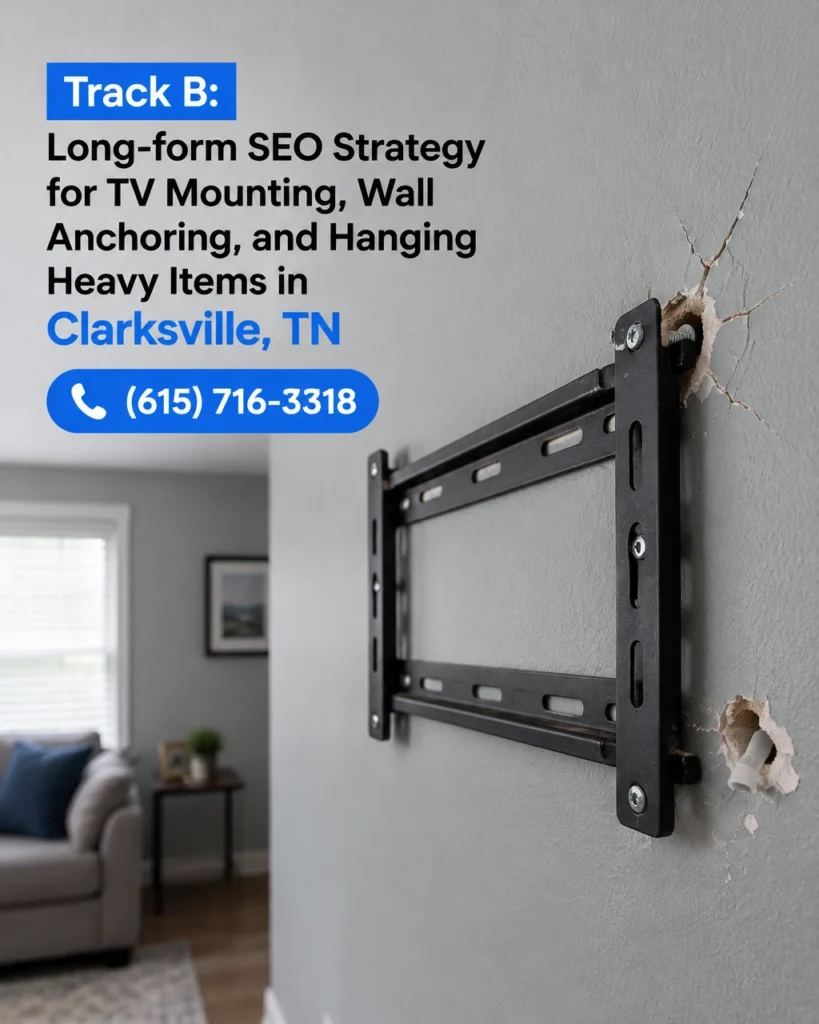
A heavy item can look secure right up until the wall starts to move. Then you notice the TV mount pulling away, a spiderweb crack in the paint, or a drywall crater where a plastic anchor let go.
That kind of failure feels stressful, especially with a large television, a mirror over a bed, or a shelf holding dishes. The good news is the damage usually shows what went wrong. The next step is matching the repair to the wall, the weight, and the mount type.
This guide covers common mistakes that cause shelves, mirrors, bike racks, and storage systems to pull out in Clarksville homes.
1. Start with the wall, not the hardware
The wall material determines how the load needs to be supported. A drywall anchor is not a substitute for a wood stud, and a fastener made for wood is not suitable for brick or concrete.
Most homes in the Clarksville area use drywall over wood framing, but some walls include metal studs, plaster, masonry, or extra drywall layers. Know what is behind the surface before choosing the anchor.
Look for these conditions before mounting anything heavy.
- Sound drywall with no soft spots or water staining
- Wood studs in a useful location
- Metal framing behind the drywall
- Brick, block, or concrete
- Plaster and lath in an older home
- Existing damage from an anchor or prior mount
A wall can look flat while the paper face is already weak. Press lightly around the planned mounting area. If the drywall feels soft, crumbles, or flexes, repair it before mounting.
A previous failure can leave more than a hole. You may see torn drywall paper, a bowed sheet, chipped paint, or a shallow crater spreading several inches from the original anchor.
The Fix It Quick drywall and ceiling service page explains why the surface needs repair before new hardware goes in.
2. Find a stud without guessing
A stud is usually the best support for a heavy TV, shelf, mirror, or garage storage rack. Guessing at the location is where many mounting problems begin.
Start with an electronic stud finder if you have one. Move it slowly across the wall and mark both edges of the stud, not just the first signal. The center should fall between those marks.
Outlets and switches can offer clues, but construction varies, so do not treat them as exact proof.
Tapping on the wall is not enough. Sound changes can help, but drywall thickness, insulation, plumbing, and room acoustics can mislead you.
For a TV mount, confirm the stud location at more than one point. A wide mounting plate may need two studs, and the lag bolts should enter near the center of the framing.
Check for nearby outlets, switches, plumbing fixtures, and unusual wall conditions before drilling.
3. Know the difference between anchors and lag bolts
A light toggle anchor and a heavy duty wall anchor do not perform the same job. Neither one automatically makes drywall strong enough for every load.
A lag bolt into a wood stud is usually the preferred method for a large TV, a full motion mount, a heavy mirror, or a shelf that will carry books.
A toggle anchor spreads force behind the drywall. That can work for some light or moderate items when the anchor is correctly rated and the drywall is sound.
The number on an anchor package can be misleading. It assumes the correct wall material, proper installation, good spacing, and a load that behaves as expected. It does not mean damaged drywall can safely hold that amount.
Use extra caution with items that get pulled, extended, or loaded from one side.
- A fixed TV mount stays close to the wall
- A tilting mount creates some added leverage
- A full motion mount extends outward and creates much more leverage
- A shelf can pull forward when weight is placed near its edge
- A bike rack receives repeated movement as the bike is loaded and removed
That leverage is why a plastic anchor may hold for a while and then tear out suddenly.
4. Choose the right TV mount
The mount style changes the force on the fasteners. A fixed mount is generally the least demanding because the TV stays close to the wall.
A tilting mount adds some forward pull. A full motion or articulating mount is more demanding because the arm extends away from the wall. The farther the arm reaches, the more force it places on the mounting points.

For a large television, safer choices usually include wood studs, a properly supported backer board, an approved metal stud system, or correctly selected masonry anchors. Ordinary plastic drywall anchors are not a good choice for a heavy full motion television.
Check more than the television weight. The mount needs to match the TV mounting pattern, often called the VESA pattern, and be rated for the screen.
A mount may be rated for several hundred pounds, but that does not override the wall. The fasteners, substrate, bracket, and installation all work together.
If the mount has already started pulling away, remove the television carefully and stop using the mount. Do not tighten the same screws into the same damaged holes. The wall needs to be repaired or reinforced first.
5. Handle metal studs, brick, and plaster differently
Metal studs can support wall mounted items, but the hardware and method differ from wood framing. Ordinary wood lag bolts may not provide enough holding power in light gauge metal studs.
Some mounting systems use heavy duty toggle hardware through the drywall and metal stud. Others require a structural backer across multiple studs. Follow the mount manufacturer’s instructions for the wall construction.
Brick and concrete need masonry rated anchors or screws. Wood lags and hollow wall toggles are not masonry anchors. Solid brick is also different from thin brick veneer.
Plaster and lath require care because the surface can crack or crumble during drilling. If possible, fasten into the wood studs behind the plaster. A heavy item should not rely on plaster alone.
Get a specialist involved if the mounting point is part of a structural wall, fireplace assembly, retaining wall, or unusual masonry system. The Network can point homeowners toward the right specialist for specialty structural concerns. The Network does not perform that work.
6. Hang mirrors, shelves, and storage safely
How to hang a heavy mirror depends on both the mirror and the wall. A framed mirror may have a wire, cleat, or metal bracket, and each system places force on the wall differently.
A French cleat or other wide mounting system can spread the load better than one small hook. It still needs solid framing or properly rated anchors.
Floating shelves create another common problem. A shelf may look level when empty and sag once books, dishes, or plants are added. One homeowner in Sango noticed a floating shelf that sagged a quarter inch at the unsupported end. The brackets were still attached, but the load and span were too much for the mounting method.
Use these checks for shelves and storage.
- Confirm the shelf length and expected weight
- Check whether the bracket reaches a stud
- Keep heavy items near supported areas
- Look for a gap opening between the shelf and wall
- Watch for fresh cracks around the fasteners
- Do not exceed the rating of the shelf hardware
The same principle applies to bike racks and garage wall storage. Repeated loading creates movement, so a system that barely holds static weight may not hold up during daily use.
The Fix It Quick carpentry installation and repair page includes shelving and other wall related carpentry needs.
7. Plan cable management and outlet placement
A clean TV installation involves more than attaching the bracket. Outlet placement and cable routing affect both appearance and safety.
A cable can run through a surface mounted raceway, behind a properly designed channel, or through an approved in wall pathway. Do not push a standard power cord inside the wall unless the system is designed and approved for that use.
Before mounting, check where the existing outlet sits. A low outlet may leave a visible cord below the TV. An outlet behind the screen can look cleaner, but relocating power is electrical work and may require a licensed electrician.
The same planning helps with shelves and mirrors. A mounting point that looks ideal may sit over a switch box, plumbing line, or cable route.
For real estate listings in Clarksville, a clean cable layout can help a room photograph better. Property managers in Montgomery County also need to think about durability and easy access.
8. Repair the wall after an anchor fails
A failed anchor needs more than a new screw. The damaged area has to be made sound before anything is mounted again.
Start by removing loose hardware and any crumbly drywall. A small clean hole may need a simple patch. A larger drywall crater may require a backing piece, joint compound, sanding, primer, and paint.
Torn drywall paper needs to be sealed before compound is applied. Otherwise, the paper can bubble and leave a rough repair. A bowed sheet or broad cracked area may mean the drywall has lost support.
A wall mount that pulled away may leave a spiderweb crack in the paint around the fasteners. Do not cover that with paint until the mounting problem is corrected.
Patch and repaint costs vary by damage and finish. A few small holes may fall around $75 to $200. Several torn holes or a larger failed mount can run roughly $150 to $600 or more, especially when texture matching or broader repainting is needed.
A small drywall patch and sanding visit may fall around $125 to $285, but these are planning ranges only. Access, materials, wall texture, paint matching, and repair size all affect the cost.
For related guidance, see the Clarksville drywall repair mistakes guide.
9. Remove wall mounts before turnover or listing
TV mount removal often comes up before a home sale, rental turnover, or room update. Removing the bracket is only part of the job.
The wall may have lag holes, toggle openings, paint damage, and a lighter rectangle where the bracket blocked sunlight. The repair may need more than filler if the drywall paper has torn.
A seller in St. Bethlehem may want the wall returned to a neutral condition before listing photos. A property manager near Fort Campbell may need the mount removed and the room patched between tenants. An investor may be coordinating similar repairs across rental properties.
Keep the mount hardware and television brackets together if they are staying with the home. If the mount is being removed, document the wall condition before patching.
The pre listing repair checklist for Clarksville homes can help organize wall repairs with other visible maintenance items.
10. Know when to get matched with a pro
Some light wall hanging is reasonable for a homeowner who can identify the wall construction and follow the hardware instructions. A small framed picture and a light shelf are different from a large television, a full motion arm, or a mirror above a bed.
Get matched with a pro when the wall has already failed, the drywall feels soft, the mount location is unclear, or the item is too heavy to handle safely. It also makes sense when several rooms need mounting, patching, paint touch up, and hardware removal.
Fix It Quick is a referral network, not a repair crew. We match homeowners, realtors, property managers, and investors with vetted local pros. The pros in the network are licensed and insured.
A general TV mounting job on sound drywall over wood studs may fall around $125 to $225 before optional hardware and wiring. Larger TVs, full motion brackets, masonry, plaster, metal studs, outlet changes, concealed wiring, and structural backers can move the planning range to roughly $225 to $500 or more.
Those are general ranges, not quotes. We do not price jobs. The matched pro reviews the wall and explains the work needed.
If you'd like to discuss a wall mounting or repair concern, call or text (615) 716-3318 or request a free match through the contact page. Share the item type, approximate weight, wall material, and any visible damage so the next step is clear.
11. Frequently asked questions
Can a heavy TV be mounted directly into drywall?
A small, light TV on a fixed mount may be suitable for properly rated hollow wall anchors when the mount and anchor instructions allow it. Larger televisions and full motion mounts should generally use studs, a supported backer, an approved metal stud system, or correctly selected masonry anchors.
How do you find a stud behind drywall?
Use an electronic stud finder and confirm the center by checking both edges of the signal. Outlets and switches can provide clues, but they should not be treated as exact proof. Do not rely on tapping alone.
Why did my plastic drywall anchor pull out?
The anchor may have been overloaded, installed in weak or damaged drywall, placed too close to another hole, or exposed to pulling force from a shelf or articulating mount. The weight rating on the package assumes proper installation in suitable material.
Can a floating shelf hold books?
It can if the shelf, brackets, fasteners, and wall support are all rated for the combined load. Books placed near the unsupported end create more leverage. Watch for a quarter inch sag, a widening wall gap, or cracking around the fasteners.
Is brick safer than drywall for TV mounting?
Solid brick or concrete can provide strong support when the correct masonry anchors are used. Brick veneer, hollow block, mortar joints, and damaged masonry require a closer review. Wood screws and drywall toggles should not be used as substitutes for masonry hardware.
What should happen after a TV mount pulls away?
Remove the TV safely and stop using the mount. Inspect the drywall for torn paper, a crater, spreading cracks, or a bowed sheet. Repair or reinforce the wall before installing the mount again, and get matched with a pro if the substrate or structural condition is unclear.