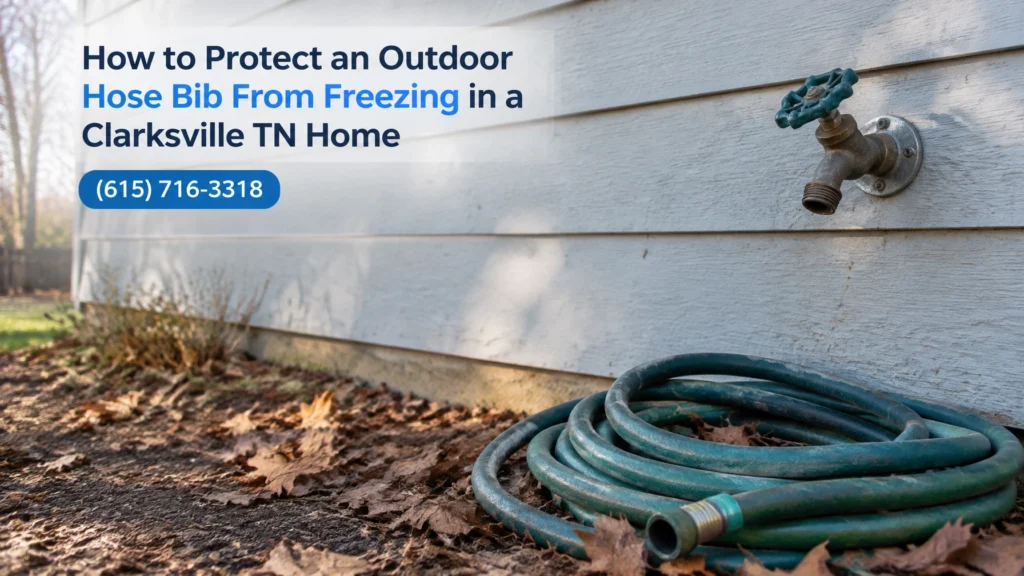
An attached garden hose is the first thing to check before freezing weather. Even a frost free outdoor faucet can freeze if a hose, timer, or nozzle keeps water from draining out.
In Clarksville, a few simple steps can help protect the faucet and the water line inside the wall. You don’t need special gear to start. Just disconnect the hose, check what kind of faucet you have, and look for any exposed pipe nearby.
1. Disconnect the hose before a freeze
Remove every hose from the outdoor faucet before temperatures drop below freezing. Drain the hose, then coil it loosely and store it somewhere sheltered, like a garage or shed. Don’t leave a spray nozzle or timer attached, either.
Here’s the deal. A frost free sillcock is designed to shut off water inside the warmer part of the wall, then drain the water left in the faucet body. A connected hose can trap that water, so it can’t drain. That’s why a hose left on the faucet is a common cause of freeze damage, even when the faucet is labeled frost free.
Check more than the main hose bib. Look for a second faucet near a back patio, garage, or side yard, especially in homes around Sango and St. Bethlehem. Clarksville Gas & Water also advises disconnecting outdoor hoses as part of cold weather preparation.
2. Check what kind of faucet you have
A frost free sillcock and a standard hose bib need different care. Frost free faucets are usually longer, with the shutoff valve set back inside the house. They still need a clear path to drain, and they can freeze if they’re installed incorrectly, sit in an unheated wall, or have an attachment holding water at the spout.


A standard hose bib shuts off close to the outside wall. If yours has an indoor shutoff valve, close it before the coldest weather and open the outdoor faucet to drain the remaining water. Leave the outdoor faucet open while the line is shut off. If you can’t find an indoor shutoff or aren’t sure how the line drains, don’t guess. A local pro can check the setup.
A Clarksville homeowner might find a short, older faucet on a side wall and assume it works like a newer frost free model. In a home near Fort Campbell, that difference can decide whether the line drains on its own or needs to be shut off and drained from inside. A quick look before the first hard freeze can make the next step clear.
One fall morning in St. Bethlehem, a homeowner walked out to a faucet with an inch of frost on the spout and heard ice creak inside the wall when the handle turned. The hose had stayed connected all season, so water sat trapped in the faucet body overnight. The pipe survived, but the close call is why the hose comes off in October now.
3. Treat the vacuum breaker as a separate part
A vacuum breaker helps keep water from a garden hose from flowing backward into the household water supply. It’s a backflow protection device, not freeze protection. Some are built into the faucet, while others screw onto the spout.
Follow the device’s instructions. If an external vacuum breaker is made to be removed, take it off for winter. If it has a drain feature, use it as directed. Don’t block its opening, force it loose, or remove an integral device permanently without providing proper backflow protection.
If the faucet drips from the vacuum breaker or doesn’t drain as expected, treat that as a reason to get it checked before freezing weather. The small parts can hold water too.
For broader fall upkeep, see our guide to fall freeze prep for Clarksville rental properties.
4. Insulate exposed lines, not the problem
Look for water pipes in an unheated garage, crawlspace, or exterior wall. Feel for a cold draft around the spot where the pipe comes through the wall, and check for a split or missing section of insulation. Foam pipe sleeves can slow heat loss, but insulation alone can’t keep a pipe warm through every long, hard freeze.

Fit insulation snugly around exposed pipe, following the product directions and keeping faucet drain openings clear. Don’t cover a vacuum breaker opening or wrap a sillcock in a way that stops it from draining. An insulated faucet cover can offer added protection after you’ve removed the hose and other attachments.
Clarksville’s cold weather precautions include protecting exposed plumbing. If the vulnerable pipe is hard to reach or you see damage, check the main water shutoff guide so you know where to turn off the water if a leak starts.
5. Know what to do if the faucet freezes
A faucet that stops flowing during a freeze may have ice in the faucet or pipe. Don’t force the handle, pour boiling water on it, or use an open flame. If there’s no leak and the area can be warmed safely, keep the home heated and let the pipe thaw gradually.
Watch for a new drip at the spout or dampness inside the wall after the temperature rises. A cracked pipe may not leak until the ice melts. If water is flowing where it shouldn’t, shut off the main water supply and get help.
In Woodlawn or another part of Montgomery County, a faucet that freezes again and again may need more than a cover. The cause could be an unheated wall cavity, a line that doesn’t drain, or a faulty shutoff. For rental homes, keep the steps with the property’s seasonal checklist and review our tips for fall pest and rodent exclusion and fall soffit and fascia checks.
If you’d like a vetted local pro to check a hard-to-reach line or a faucet that won’t drain, call or text (615) 716-3318 or request a free match online. Fix It Quick Network matches homeowners, realtors, property managers, and investors across Clarksville and Montgomery County with local pros. The pros in our network are licensed and insured. Start by noting which faucet is affected and whether it has an indoor shutoff. If the line has already split, close the main shutoff first so the repair doesn’t turn into water damage.
6. FAQs about outdoor faucet freeze protection
Should a frost free faucet still have a cover?
A faucet cover can add protection, but it doesn’t replace disconnecting the hose. Make sure the faucet can drain before fitting a cover.
Should the outdoor faucet be left open all winter?
Only when the indoor shutoff for a standard faucet is closed and the line has been drained. Don’t leave a faucet open as a substitute for finding out how it’s built.
Is pipe insulation enough to stop a freeze?
No. Insulation slows heat loss, but a long freeze can still affect an exposed line. Fix cold drafts and make sure the faucet drains.
What if the faucet has a vacuum breaker?
Follow its instructions. Remove it only if it’s designed to be removed, or use its drain feature if provided. Don’t block its opening.
What should be done first before a freeze?
Disconnect and drain the hose, remove any timer or nozzle, then check whether the faucet drains and whether nearby pipes are exposed. Start with those checks, and arrange a pro match if anything is unclear.