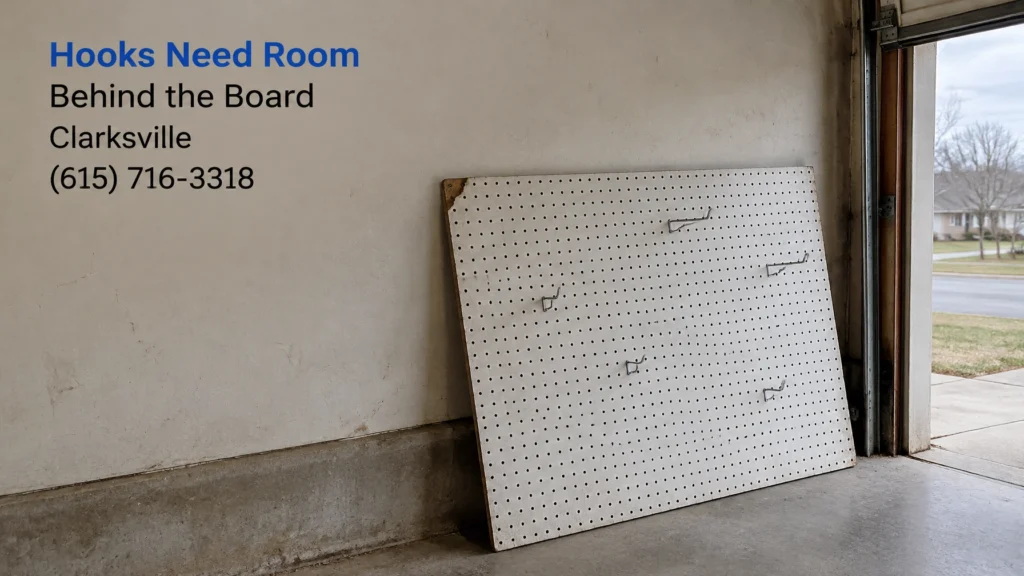
1. What a pegboard actually needs behind it
A pegboard screwed flat to the wall is the most common mistake. A pegboard hook is not a nail. Its lower leg drops down and back into the space behind the panel, where it catches the board. Without that gap, there’s nothing for the leg to catch, so the hook sits loose and can walk out under load.
One homeowner screwed the panel straight to the drywall, and every hook sat with a visible tilt because nothing was behind the hole for the lower leg to catch. Leave roughly three eighths of an inch to three quarters of an inch between the wall and the panel. Thin wood strips screwed to the wall first create that space, then the panel fastens to the strips.
There’s another cost to skipping the gap. The panel can trap moisture against the wall, and its back stays cold through winter. In a Clarksville garage, that’s a reason to leave room for air behind the board, not just for hooks.
2. Pick the wall before buying the panel
The wall choice decides everything. Find the studs behind the drywall first, because the backing strips need to land on framing. Skip the wall beside the garage door track, the wall a car door swings into, and any spot where the panel would cover an outlet or hose bib.
Keep the panel off a shared wall against a damp basement, and away from any wall with a water stain. A panel over a wet wall hides the problem instead of fixing it. In Montgomery County homes, a musty smell or a dark stain is a good reason to check the wall before adding storage.
Think about what else needs to fit. Clarksville homeowners planning shelves too can compare the wall layout with this guide to garage shelving. Measure the space and leave access to switches and plumbing.
3. Match the panel and the hooks to each other
The hole and hook need to fit. Standard one eighth inch hardboard with small holes takes short shank hooks. Quarter inch hardboard or a metal panel takes longer quarter inch hooks. Buying quarter inch hooks for an eighth inch board is a common reason hooks fall out.
Tempered hardboard holds up better in a garage than the thin panel sold for craft rooms. Metal panels are another option, but check that the hooks match that panel. A hook that feels loose in the hole won’t become secure just because it’s holding something light.
Paint the panel before hanging it. One coat on both faces and the edges helps protect the board, because a bare panel can swell at the edges in a humid garage. In a Sango garage that swings from humid summers to cold winters, that edge coat is the difference between a flat panel and a wavy one.

4. Run the strips and get them level
Good support starts with a straight reference line. Snap a level line at the top of the panel, then cut thin one by two or one by three strips to fit. Screw each strip so the fastener lands in framing.
Run strips vertically along the stud lines, then add short blocks at the panel’s top and bottom edges. Keep the strips an inch or two short so the panel overhangs and looks clean. Set the panel in place and drive screws through its holes into the strips, not into the drywall.
Don’t overdrive the screws into hardboard. Too much pressure crushes the hole and can leave a loose corner. If a screw head is damaged during installation, stop before forcing it and review this guide to a stripped screw. On a wide wall near Fort Campbell, check that the strips stay level and firmly fastened.

5. Load it from the bottom up
Start with an empty panel. Put heavy items low and lighter items high, and use two hooks under anything with weight, spaced wide. That spreads the load and helps keep the panel from bowing.
A hook that bent and pulled a teardrop shaped hole in the board because someone hung a full five gallon bucket of paint on one hook is a clear sign to stop and reassess the load. Don’t hang a ladder, bike, stroller, or bag of concrete from pegboard hooks. Those need a wall bracket rated for the weight, because a pegboard is not a bracket.

For materials, a basic panel, strips, and hooks might run about $40 to $150, depending on size and board type. A long wall in a Woodlawn garage sits at the upper end. That’s general guidance, not a quote. Cost changes with panel size, whether the wall needs repair first, and whether the strips can reach studs.
6. Check it after the first cold snap
Clarksville humidity swings make a seasonal check worthwhile. Before winter, press a palm against the panel and look for a bow between screws, shifted hooks, a soft spot near the bottom edge, or a dark chalky line where the panel meets the wall. Those signs are easier to deal with before the board is full.
A small bow may need just one more screw into a strip. A soft edge or damp shadow on the wall means the panel should come off so the wall can be checked. A St. Bethlehem homeowner found the drywall behind a panel cold and damp, with a faint outline of the board on it. The panel went back up on strips and stayed dry.
Keep the rest of the garage in mind, too. This guide to preparing a garage floor before winter covers another place moisture can show up. Fix It Quick Network is a referral network, not a repair crew. We match homeowners with vetted local pros at no cost, and the pros in our network are licensed and insured.
If you’d like help with the wall or the installation, call or text (615) 716-3318 or request a free match. Homeowners can choose whether to tackle the work themselves or get matched with a pro. A practical next step is to check the wall and mark the studs before buying a panel.
Frequently asked questions
Can a pegboard go straight on drywall?
No. The hook’s lower leg needs space behind the panel to catch. Backing strips create that gap and give the panel a solid fastening point.
How much weight can a pegboard hold?
There isn’t one safe weight for every setup. The panel, hook, fasteners, spacing, and wall support all matter, so check the product ratings and keep heavy items on rated brackets. The panel is rarely what fails first, the wall and fasteners are.
Do the strips have to reach a stud?
The strips should be fastened to studs wherever possible. That gives the panel a stronger base than drywall alone. If the layout makes that hard, get advice on the right support before loading the board.
Why do the hooks keep falling out?
The panel may be mounted flat against the wall, leaving no space for the hook’s lower leg to catch. The hook may also be the wrong size for the panel’s holes. Check both the gap and the hook fit.
Is a pegboard a bad idea in a damp garage?
It can be a poor choice over a damp or stained wall, because the panel can hide moisture and stay cold behind. Find and address the moisture first. If the wall is dry, leave a gap behind the panel and check it after cold weather.