1. What insulating a garage door actually does, and what it does not do
Start with the honest version. In a Clarksville home, your garage door is usually the biggest flat surface in the house, and most steel doors are one thin sheet with nothing behind it. Insulation slows heat moving through that sheet, so the garage stays a few degrees warmer on a January night and the opener runs quieter.
Insulation won’t heat your Clarksville garage or turn it into living space. If your bonus room is cold, the ceiling above the garage may lack insulation or the room may not have a supply duct. A cold bedroom over a garage usually has two problems stacked, a thin ceiling and a thin door panel. The door is the cheaper half.
In Sango, a homeowner insulated both garage door panels with foam board in late November. The garage got warmer, but the bonus room stayed cold, and a loose attic hatch in the ceiling was pulling cold air down all winter. That’s why winter comfort can call for indoor humidity and dry air checks and a look above the garage. For gaps and opener checks, see garage door winter readiness checks, which covers those while this one covers the panels.
2. Check what is on the door before buying anything
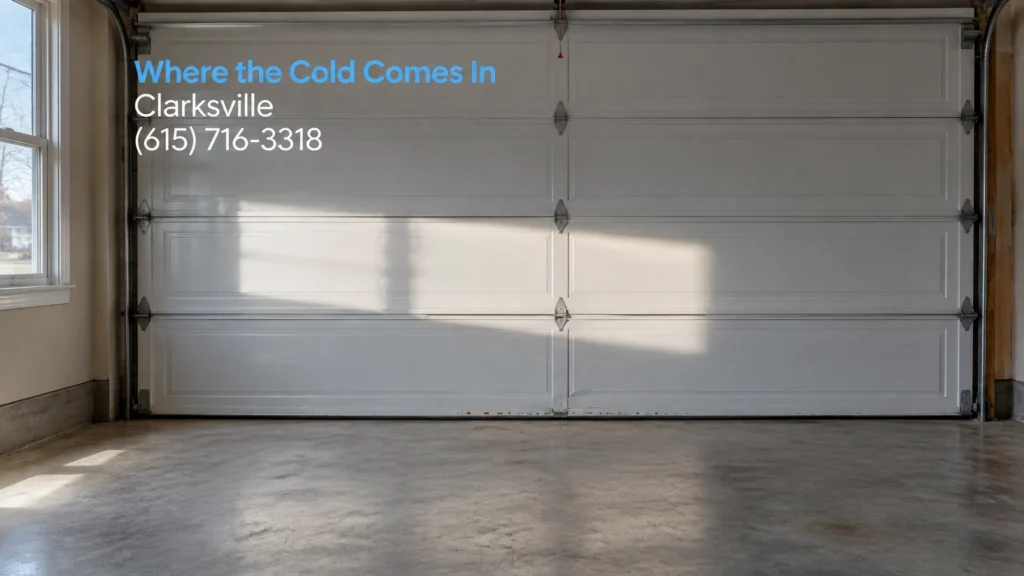
Most steel doors have shallow recessed cavities on the inside face, while some are completely flat and a few already have thin factory backing. Read the manufacturer sticker, often near the top or bottom of a panel, and check the door weight or panel rating before adding anything.

Find the long horizontal reinforcement bar, called a strut, and plan around it rather than over it. A shallow dent with rust freckles along the fold where the bottom panel meets the seal, a cracked panel, a window panel, or a door that already struggles to lift means this isn’t a simple insulation job. Measure one cavity’s depth with a ruler and write it down, then choose material that fits inside rather than proud of the face.
Check the door between the garage and the house separately. Its seal can matter more to a cold room than the big door in St. Bethlehem or Woodlawn homes.
3. The weight question comes before the foam
Test the door before adding weight. With the door closed, pull the opener release so it moves by hand. Lift it to about halfway and let go. A balanced door holds there. If it creeps down or feels heavy at the top, stop. Don’t add insulation to a door that’s already out of balance.

Any insulation adds weight. Foil faced foam board adds very little, while fiberglass kits add more, and either choice changes how the springs balance the door. Springs, cables, drums, and brackets are high tension parts, not homeowner work. No spring adjustment with a winding bar, a video, or a helper, and this article won’t walk you through one.
Repeat the halfway test after insulation goes in. If the door drifts, stop using the opener and get a garage door technician to rebalance it. That’s a spring job, not a handyman job. The same rule applies across Montgomery County. An opener isn’t a fix for an unbalanced door.
4. Choose material that fits the panel
Rigid foil faced foam board is light, easy to cut, and scores cleanly, and depending on thickness it lands around R 4 to R 8. Fiberglass kits come sized for standard panels and can be cut to fit, but they’re heavier and messier, and loose fibers end up on your car.
Treat the R value on the box as a rough guide, measured at the center of a panel rather than across the whole door assembly. A layer of foil alone is mostly a radiant barrier and does little. Cut your insulation to the cavity, press it in snug, and stop well short of the hinge line so the hardware can move.
A cold slab is the other reason a Fort Campbell garage can feel raw in December. See a garage floor prepped for winter for that part of the problem.
5. Install it so the door still works
Start with a clean, dry panel. Dust and grit can keep tape from sticking. Cut the material slightly oversize, press it into the cavity, and run foil tape along seams and edges.

Keep the hinge line, roller brackets, track path, opener arm, bottom seal, and photo eye clear. Don’t cover a warning label, a strut, or a window panel. Watch the added weight as you go, especially on a two car door with many panels.
Move the door by hand twice before using the opener, and listen for rubbing. Then run the opener and watch the full travel. If a new groan, a hesitation at the top, or a panel rubbing the frame shows up, something needs checking.
6. Know when to get matched with a pro
Get matched with a pro for a bent or cracked panel, a broken spring, a door that jumps the track, or a door that won’t hold halfway. Same for a torsion spring that needs adjusting or a door that came down crooked after a power outage reset. A garage being converted into living space needs a wall, ceiling, and HVAC check, not door insulation.
A listing that needs a tidy, dry garage for showings may need panel or seal work, and property managers with several tired steel doors may want the same checks across units. Fix It Quick Network is a referral network that matches homeowners with vetted local pros, and the pros in the network are licensed and insured. Fix It Quick Network can match you with a vetted local pro for panel or seal work, while a spring or balance problem needs a garage door specialist rather than a general handyman.
If you’re looking at a garage door opener that will not close, remember that a door that reverses or stops is a safety device doing its job, not a door asking for more insulation.
If it would help to have a vetted local pro in Clarksville look at the door before winter, choose whichever next step feels easiest. Call or text (615) 716-3318, or request a free match at the contact page. Start by noting the door label and whether it holds halfway.
Frequently asked questions about garage door insulation
Does insulating a garage door make the garage warm
No, insulation slows heat loss but doesn’t create heat. You may notice a more moderate temperature, but an unheated garage will still feel cold in winter.
How much weight does garage door insulation add
The added weight depends on the material and how many panels your door has. Use the halfway test before and after, because the opener isn’t designed to compensate for a door that came out of balance.
Can you put insulation on a garage door with windows
No, leave the windows alone. A window panel is the reason to cut around a panel rather than fill it.
Is foil faced foam better than a fiberglass kit
Foam board is lighter and easier to fit in shallow cavities, while fiberglass kits are heavier and can shed fibers. Choose the option that fits your door and leaves the moving parts clear.
Should the garage door be insulated before selling a house
Insulation can make the garage feel more comfortable, but it won’t fix a cold room above it if the ceiling or air leaks are the real issue. Check the door’s balance and condition before adding material.