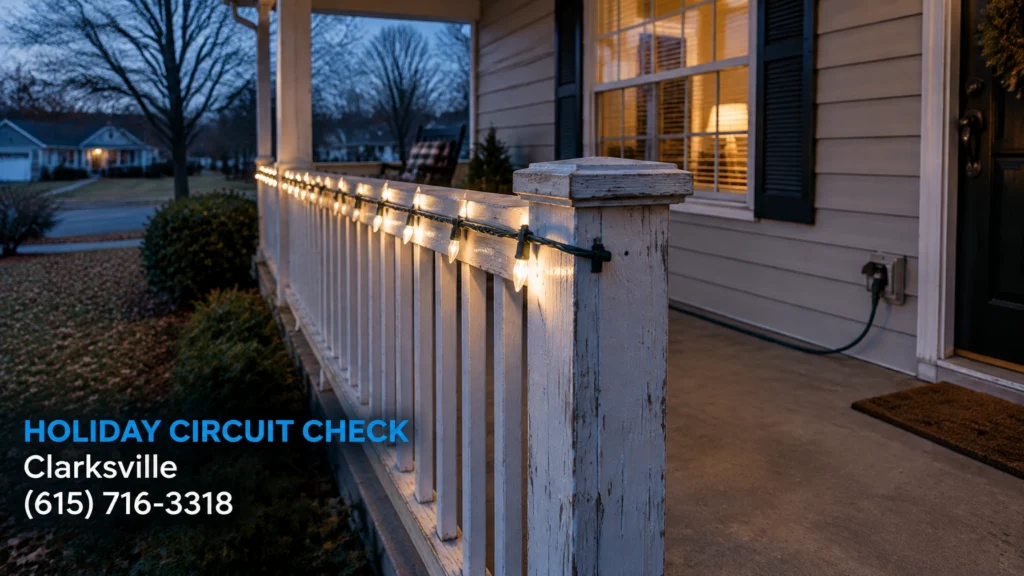
From Thanksgiving on November 26 through New Year's, holiday lights put extra demand on home circuits. If lights flicker or a breaker trips, the problem may not be the outlet closest to the decorations. Other receptacles, garage lights, and indoor lamps can share that same circuit.
Fix It Quick Network connects homeowners and property managers with vetted local pros. Here's a simple way to check your setup.
1. Holiday lights put circuit sharing to the test
The number of light strings doesn’t tell you the whole story. What matters is the total electrical load on the circuit, including what’s plugged in around the house. A porch outlet may share a circuit with a garage or a room inside.
A St. Bethlehem homeowner plugged one 40 foot outdoor light string into a porch outlet. Within an hour, part of the porch outlet and the garage lights went dark together. Shared circuits matter more than the number of strands you can see.
Before decorating a Clarksville home or rental, check what else will be running at the same time. A space heater, freezer, or other high demand appliance can leave less room for lights. You don't need to guess or take anything apart.
2. Map outlets before adding more lights
A quick map can make an unclear circuit easier to understand. Write down the porch, garage, and room outlets you plan to use, then note which ones lose power when a breaker is switched off.
Use the panel's existing breaker switches to check one circuit at a time if you're comfortable with that. Don't remove the panel cover or touch wiring, and don't deliberately overload a circuit just to see if it trips.
Plug in one string and check that it works normally before adding another. If a breaker trips, stop adding lights rather than resetting it to finish the display. If the panel labels are unclear or the circuit keeps tripping, leave the investigation to a licensed pro.
For a separate look at outdoor receptacle condition and moisture concerns, see our fall outdoor outlet and GFCI safety checks. That's a different check from tracing which rooms and outlets share a circuit.
3. Warm plugs and flickering lights are warnings
A plug or cord that feels warm is a reason to unplug the lights, not something to watch and wait on. Also look for a browned outlet face, a loose plug fit, buzzing, or a burnt smell.
Lights that dim or flicker when another appliance starts can point to a circuit under strain or an electrical problem. A breaker that trips twice in one evening deserves attention, not another reset.


If the plug is hot or you see damaged insulation, don't handle the connection while it's plugged in. Keep people away from a visibly damaged outlet and arrange for a qualified pro to check it.
4. Avoid cord habits that add risk
A cord can be damaged or overloaded even if the lights still turn on. Look along its full length for frayed insulation, crushed sections, loose connections, and cracked sockets. Replace damaged cords and light sets rather than taping them up.
Watch for these common trouble spots.
- Connecting strings beyond the limit printed on the product label
- Hiding a higher wattage lamp among low wattage lights
- Pinching or crushing a cord behind furniture
- Securing a cord with staples or nails
- Running a cord through a window gap or doorway
Use extension cords marked for the intended indoor or outdoor use, and check the cord's rating and the light string's instructions before connecting them. The CPSC holiday decoration safety tips advise against overloading outlets and say to connect no more than three sets of incandescent lights. Follow the product's own instructions, since its limit may be lower.
5. Use the labels to make sense of circuit load
The watt rating tells you how much power a light set uses. The amp rating tells you how much electrical current it draws. For a 120 volt home circuit, divide the total watts by 120 to estimate amps.
For example, 600 watts of lights draw about 5 amps. That's only the lights, though. Any other equipment on the same circuit adds to the total, and the extension cord and light set must each be rated for the load.
A common 15 amp circuit has a theoretical ceiling of 1,800 watts, but a long running load is generally planned at a lower level. The actual room may be smaller still if a garage freezer shares the circuit. Don't treat a general calculation as permission to exceed the ratings printed on the cord or the lights.
If the labels allow it and the circuits are truly separate, spreading lights across the porch, garage, and an interior circuit may reduce demand on any one circuit. Different outlets don't always mean different circuits, so use your map rather than assuming. LED strings often use less power than incandescent strings, but check the label and connection limit for every set. Our fall storm and power outage prep guide covers other seasonal planning for Clarksville properties.
6. Know what kind of help fits the problem
A simple issue may come down to where lights are plugged in or whether an outlet location works for the display. A pro can check a suspected GFCI problem or look into a receptacle that doesn't behave normally. A new dedicated exterior receptacle may need a new circuit, so the right licensed electrician should handle that work.
Full panel work, repeated breaker trips, scorched outlets, and circuit changes belong with an electrician. The pros in the Fix It Quick Network are licensed and insured, and the Network matches customers with vetted local pros suited to the work.
Realtors preparing a Clarksville home for a holiday showing should know that buyers' inspectors may notice dimming lights or scorched outlets. Property managers can record light string and circuit issues during turnover. For investors managing homes in Sango, Fort Campbell, or Woodlawn, a warm plug head or repeatedly tripping porch circuit is worth adding to the turnover list. Montgomery County owners can keep the same notes with each property's maintenance record.
If you'd like help sorting out a repair, call or text (615) 716-3318, or request a free match through the contact page. Share which lights or outlets are affected and what you noticed.
Frequently asked questions
Does a longer string of lights overload the circuit if everything works for the first hour?
Not necessarily. The load depends on the string's wattage and everything else on that circuit. A breaker may trip after more devices are running, so check the labels.
Can a tripped GFCI mean the lights themselves are bad?
Yes. A damaged string or cord can contribute to a trip, though moisture or a problem with the GFCI or circuit may also be involved. Stop using the lights if the device won't reset or trips again.
Why do porch lights dim and flicker when the tree lights are on?
The lights may share a circuit with other loads, or there may be a wiring or connection issue. If reducing the load doesn't stop the flicker, get a qualified pro to check it.
Should the breaker be reset if it trips twice in one evening?
No. Stop using the display rather than repeatedly resetting the breaker. A circuit that trips more than once needs the cause checked.
When does a circuit that keeps tripping go to an electrician?
A circuit that continues to trip, or has a warm plug, browned outlet, buzzing, or burnt smell, calls for a licensed electrician. Don't keep using the circuit while you wait for it to be checked.