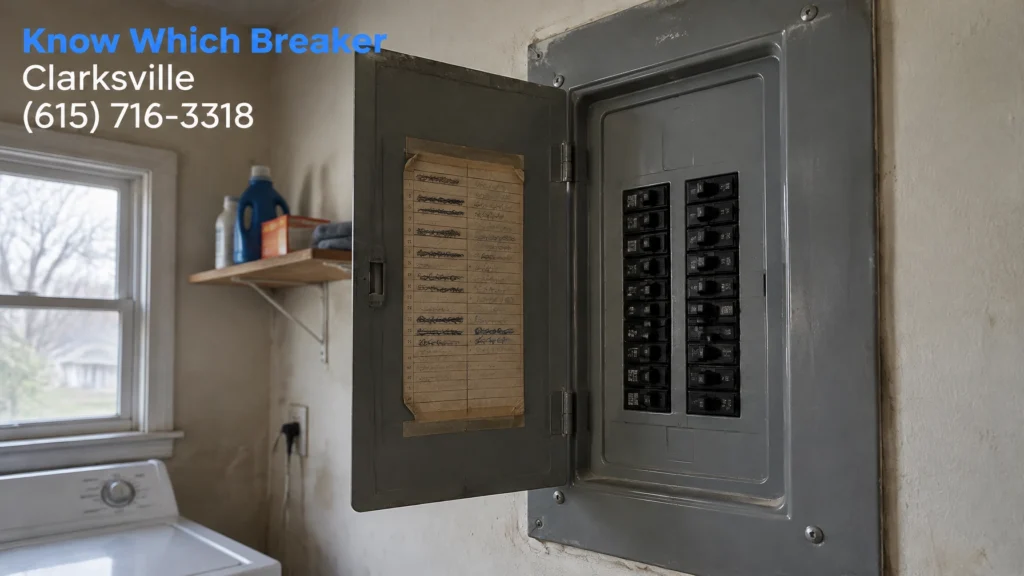
A panel directory is safety equipment, not just a chore to get around to. If a breaker needs to be shut off quickly, a clear label can keep someone from guessing in the dark or flipping the wrong switch. The goal is an accurate map, made without opening the panel, and labels that a stranger can understand.
1. A wrong label is worse than no label
A vague label can send someone to the wrong breaker when there’s a spill, a sparking cord, or a burning smell. It can also waste an electrician’s time and add cost to a diagnostic visit. In rentals and investor properties, the directory belongs with the property records. A property manager who can’t identify the water heater breaker at 11 pm is facing a call nobody wants.
In a Clarksville laundry room, an old handwritten index card may be the only guide. The ink has faded to gray, half the lines are crossed out, and different people have rewritten them over the years. Treat that card as a clue, not a reliable map.
If a circuit keeps shutting off, an accurate directory can help identify what else loses power. Read a breaker that keeps tripping for more on what repeated trips may mean.
2. Map the house without opening the panel
Keep the dead front on. That’s the flat metal cover around the breaker handles. Work only with the handles on the outside. Bus bars and lug terminals behind the cover can stay live even when the main breaker is off.
Use one helper, one room at a time, and a plug-in nightlight carried from room to room while the helper watches for the receptacle that just went dead.

Sketch a rough floor plan before testing, and write in pencil. The first pass is often wrong somewhere. Switch off one breaker at a time, have the helper call out what stopped working, then restore that breaker before testing the next one. Don’t rely on old labels except as hints to check.
3. Follow an order that saves time
Start with the big double pole breakers, which have two handles tied together. They often serve the dryer, range, outdoor air conditioner, or water heater. Record both breaker numbers for each one, and don’t assume the old label is right.
Next, check general purpose circuits room by room. Test receptacles first, then ceiling lights, then outdoor outlets, the garage, shed, and any well or sump pump. A Clarksville home may have outlets in two rooms on one circuit, so note every location that goes off together. In Sango or St. Bethlehem, that detail can be especially helpful in a rental with frequent turnovers.
Mark critical circuits separately. Include the furnace blower, sump pump, chest freezer, and any medical equipment. Someone should know not to shut those off just to change a light.
If kitchen outlets are shared, note which ones lose power together. That can be useful if there’s a slow cooker, roaster and air fryer on one kitchen circuit. Make the same kind of note for holiday lights and extension cord circuit checks.

A Clarksville homeowner hosting a big family dinner had the outlet behind the roaster quit mid afternoon, so she flipped the breaker marked Kitchen. That killed the dining room, the living room lamps, and the router, while the roaster’s outlet turned out to be on a breaker marked Bedrooms. Dinner landed twenty minutes late, and the directory got rebuilt that weekend.
4. Write labels a stranger can use
Use a room and a position. “Kitchen counter right” says more than “Kitchen,” and “Bedroom 2 north wall” is clearer than “Bedrooms.”
Note where a GFCI or AFCI breaker is located, so the next person knows to look for a test button instead of assuming a circuit is dead. If an outlet’s reset button is involved, the guide to reset a GFCI outlet may help explain what to check safely.
Print the finished directory if possible, then tape or mount it inside the panel door without covering the manufacturer’s information. Take a clear photo and save it with the property records. Paper can fade, peel, or get lost, so a digital copy helps with future maintenance and storm and power outage prep.

5. Know when the panel itself is the problem
Some panels aren’t a labeling project. Federal Pacific Stab-Lok and Zinsco panels have known failure histories and deserve a licensed electrician’s attention, not a fresh directory alone. If the brand is visible on the door or label, don’t remove the cover to investigate.
Stop and get help if you notice scorch marks, a burnt smell, buzzing, a breaker that feels hot, rust or water staining, or missing breaker blanks that leave open holes. Don’t open the dead front to check for two wires under one terminal or aluminum branch wiring. If either issue is known or suspected, leave that inspection to an electrician.
A subpanel with no directory may need a pro as well, because tracing its circuits can involve checking feeders. A basic electrician evaluation may cost in the low hundreds. Panel replacement can run into several thousand dollars depending on service size, permits, and access.
6. Know when to get matched with a pro
Labeling is a reasonable homeowner job when the panel looks sound and the handles operate normally. Hand it off if you see any warning signs, if there’s no main breaker, or if the panel is full and someone wants to add a circuit. A house that has been added onto more than once may have circuits that don’t make sense without professional tracing.
A realtor may need a clear directory before a listing goes live, with no time to check every room. Property managers in Montgomery County may need the same process repeated across several units. Whether a property is near Fort Campbell or in Woodlawn, the right referral for panel work is a licensed electrician. The pros in the Fix It Quick Network are licensed and insured.
If you’d like help finding the right local pro, the Fix It Quick Network can match you with a vetted local electrician. Call or text (615) 716-3318, or request a free match at the contact page. Start by noting the panel’s visible warning signs and which rooms need mapping. That gives the next person a practical place to begin.
Frequently asked questions
Why does the panel label matter so much?
A clear directory helps someone shut off the right circuit without guessing. It can save time during a repair, outage, or urgent situation, and it gives future owners or tenants a useful property record.
How long does it take to map a house panel?
It depends on the home’s size and how many circuits need checking. A small home may take an hour or two, while a larger home or one with unclear circuits may take longer.
Does the panel have to be opened to label it?
No. Keep the dead front in place and use only the breaker handles on the outside. Don’t touch wiring or remove the cover.
What if one breaker seems to control two rooms?
Write down both rooms and any specific outlets or lights that lose power. A breaker can serve several areas, so list what testing confirms rather than guessing from the room name.
Should the directory be updated before selling a house?
A current directory is useful for buyers, inspectors, and future repairs. If time is short or the circuits are unclear, ask a licensed electrician to map them.