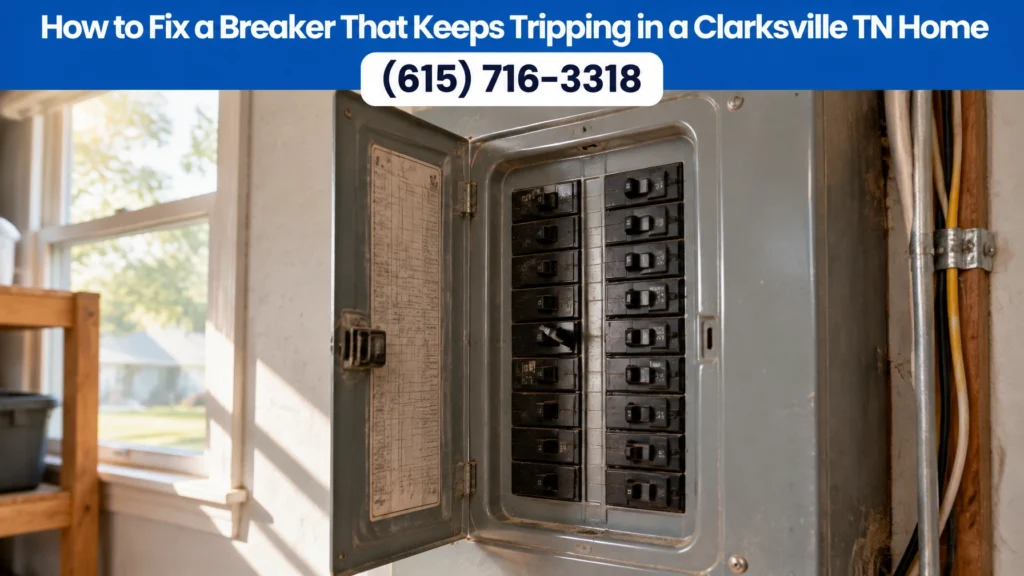
A breaker that keeps tripping is giving you information. The circuit is pulling more electricity than it should, or there is a fault somewhere in the wiring, outlet, cord, or appliance.
Resetting it again and again is not a fix. It can leave a real problem hidden, especially if the breaker feels loose and warm to the touch, or you notice a burnt plastic smell.
This guide explains what to check safely in a Clarksville home, what the timing of the trip can tell you, and when to get matched with a licensed electrical pro.
1. Start with what the trip is telling you
A breaker trips to interrupt power before an overloaded or damaged circuit creates more trouble. The cause may be too many appliances running at once, or a short circuit, ground fault, arc fault, or failing breaker.
Notice when the trip happens.
- The breaker trips as soon as you reset it.
- It trips when one appliance starts.
- It trips when several appliances run together.
- It trips at the same time every day.
- It trips during rain or when an outdoor outlet is used.
A St. Bethlehem homeowner had a space heater, television, and vacuum cleaner sharing one circuit. The breaker tripped nearly every evening around dinner, when all three were running.
That pattern points more toward an overload than a random failure. Homes in Clarksville and Montgomery County often have older circuits that were not designed for today’s chargers, heaters, kitchen appliances, and electronics.
2. Reset the breaker the right way
First, turn off or unplug the appliances on the affected circuit. Check the panel directory and look for the room or outlet listed on the label, but labels can be wrong in older Sango and Clarksville homes.
Stand to the side of the panel and look for the breaker handle that is sitting between the on and off positions. Push it firmly all the way to off. Then move it firmly to on.
Do not hold the handle in place. Do not replace it with a larger breaker. Do not remove the panel cover.
If the breaker stays on with the loads disconnected, reconnect appliances one at a time. Stop when the breaker trips again. That appliance, cord, power strip, or outlet should stay out of use until the problem is checked.
If it trips immediately with everything unplugged, leave it off. A breaker that will not stay reset needs a licensed electrician.

3. Separate an overload from a fault
An overload happens when several high demand items share one circuit. A microwave and coffee maker running together can trip a kitchen breaker, and so can a space heater or hair dryer.
A short circuit often trips the breaker immediately. It can come from damaged wiring, a loose outlet, a bad appliance, or a damaged cord. Do not keep testing an appliance that trips it instantly.
A ground fault happens when electricity finds an unintended path to ground, often through moisture or damaged insulation. An AFCI breaker watches for arcing that can raise fire risk, so neither GFCI nor AFCI protection should be bypassed.
For a related lighting issue, the guide to replacing a light switch in a Clarksville home explains why a warm, buzzing, or unusual switch should not be treated as a simple swap.
4. Check heat, load, cords, and outdoor protection
Dryers, ranges, water heaters, and portable heaters can use a large share of one circuit. Holiday lights add load too, especially through one power strip.
Extension cords are for temporary use, not permanent wiring. Use an outdoor rated cord outside, and do not plug one power strip into another. A warm cord, loose plug, or scorch mark means the setup should be disconnected if it is safe.
A GFCI that will not reset, or an AFCI breaker that trips with normal loads, needs more diagnosis.
The fall outdoor outlet and GFCI safety guide has more practical checks for homes near Fort Campbell, Woodlawn, and the rest of Montgomery County.
5. Know the panel warning signs
Leave the breaker off and get matched with a licensed electrical pro if you see these signs.
- Rust inside or around the panel
- Scorch marks or melted plastic
- A burnt odor, buzzing, or crackling
- A breaker that feels hot
- A breaker handle that feels loose
- A panel cover screw missing so the dead front sits slightly proud
- Two wires under one breaker terminal, sometimes called a double tapped breaker
- Water stains or dampness near the panel
Do not open the panel to inspect these issues. The pros in the Fix It Quick Network are licensed and insured for the work they perform, and the Network connects customers with the right local specialist rather than performing electrical repairs.
Cost depends on the cause. A diagnostic visit may run around $95 to $150, and a standard breaker replacement may range from about $45 to $280. Panel repairs can range from roughly $150 to $1,500, depending on heat damage, access, and obsolete equipment.
A larger panel upgrade costs much more. Ask for an itemized written estimate with parts, labor, permits, and inspection costs.
6. Know when to get matched with a pro
A single trip after several high load appliances run together may be a simple load problem. Move the load to a separate circuit, and keep a space heater off power strips and extension cords.
A breaker that trips at the same time every day may still point to a predictable load, but it could also involve a failing appliance or connection.
Leave the breaker off and get matched with a licensed electrician if it trips again after one careful reset, will not stay on, feels warm, smells burnt, or trips with nothing connected, or if you see rust, scorch marks, buzzing, a loose handle, or a double tapped breaker.
If you'd like help finding the right local pro, call or text (615) 716-3318, or request a free match through the contact page. Send a photo of the panel label and the breaker that trips, along with a note about when it happens. That gives the next person a place to start.
For seasonal electrical and heating concerns, the fall heating system checks for Clarksville homes and the smoke detector chirping guide may also help.
7. Frequently asked questions
Why does my breaker trip at the same time every day?
A predictable load may be starting at that time, such as a space heater, water heater cycle, dryer, or kitchen appliance. Note what is running before the trip.
Can I keep resetting a breaker that trips?
No. Reset it once after turning off or unplugging the connected loads. If it trips again, leave it off and get matched with a licensed electrician.
What should I do if a breaker feels hot?
Turn it off if you can do so safely and do not touch the panel wiring. Heat, a burnt plastic smell, buzzing, or scorch marks require a licensed electrical pro.
Why do the microwave and coffee maker trip the same breaker?
Both appliances can draw significant power. Running them together may overload one kitchen circuit in an older Clarksville home. Use separate circuits when possible and do not install a larger breaker.
Why does my GFCI breaker keep tripping?
Moisture, a damaged cord, a failing outlet, or a ground fault may be responsible. Do not bypass the GFCI or keep resetting it if the cause is unclear.
Is a double tapped breaker dangerous?
It can indicate that the panel connection is not set up correctly for the breaker. Do not remove the panel cover or try to correct it yourself. Have a licensed electrician inspect the panel and wiring.